To start this issue I would like to draw your attention to an otherwise marginal article, if it weren't for the conclusions it draws.
Looking at how Nobel prize winners were drawn into declaring their support for genetically modified organisms the oneworld (Nov. 7) article's author comes to some revealing disclosures.
Main news from Cambodia is it's unsuccessful bid to become World's Best Rice; apparently the competition has decided not to be upstaged by Cambodia. The Phnom Penh Post (Nov. 21):
Well, I doubt this will have any effect, bills need to be paid and who says that prices will rise in the (near) future?
Sectoral news, one wold say in the same vein. The Phnom Penh Post (Nov. 25):
In a buyers market with depressing prices, Cambodia's produce is simply not competitive enough with the same private monies opting for better opportunities elsewhere.
There's more to note on this issue. The Phnom Penh Post (Dec. 1):
The examples highlighted were all of either limited impact or niche products where prices tend to not follow market prices as much as the mainstream products.
Even more marginal comes this bit of rice news from the Phnom Penh Post (Nov. 7). Tedious at the least:
There's lots to report from Thailand as saving the rice farmers (or at least the notion of saving) has propelled the ingrained instability of rice market to the forefront. Prior apologies for the what has turned out to be a seemingly never ending list of links and quotes ...
Same same. The main problem are prices dropping just before the majority of Thailand's rice harvest.
Though rice prices are very much dependent on the world market, in Thailand much effort is wasted on the blame game.
The Bangkok Post on November 4:
The Bangkok Post (Nov. 13) notes:
And on November 26:
Finally to sum up the not so regional rice news section, the Vientiane Times (Nov. 25):
Well if rice is not moving what is? The Phnom Penh Post (Nov. 23):
Looking at how Nobel prize winners were drawn into declaring their support for genetically modified organisms the oneworld (Nov. 7) article's author comes to some revealing disclosures.
Though this saga has been highlighted earlier on this site, let's start with part of the article's intro:
'In June this year it hit the newspaper headlines. More than a hundred Nobel laureates call upon Greenpeace to immediately cease their resistance to genetic modification (GM). In specific the environmental organization was blasted for it's campaign against so-called “Golden Rice”, a genetically engineered rice variety
...
Regulatory barriers for GM-technology should therefore be eased, the letter urges, and calls on “governments of the world“ to make this happen'.
The
article reveals
The Guardian (Nov. 30) has a similar article but then on the bigger picture.
Cambodia- That Greenpeace does not "frustrate" the work of IRRI on Golden Rice,
- that Greenpeace were not allowed to defend themselves at a press conference in Washington D.C., being refused entry by a representative of a PR firm who was formerly head of Monsanto's corporate communication,
- the same person also provided public affairs guidance to the Nobel winners,
- the same representative is a fixer between industry and scientists which seek to discredit organic food industry,
- with this in mind there is apparently a target list of well-known / influential GMO doubters,
- that the leader of Nobel Laureates efforts in this cause has a private stake in allowing wider acceptance of GMO's.
The Guardian (Nov. 30) has a similar article but then on the bigger picture.
Main news from Cambodia is it's unsuccessful bid to become World's Best Rice; apparently the competition has decided not to be upstaged by Cambodia. The Phnom Penh Post (Nov. 21):
'Cambodia's Phka Rumdoul variety of fragrant rice, which won the World’s Best Rice award for three consecutive years from 2012 to 2014, narrowly missed its fourth crown at this year’s awards held in Chiang Mai in northern Thailand last week'.Other news from the Kingdom's rice scene. Main point is of course the decreasing price for the fresh harvest.
Solving problems the Khmer way. CNV.org (Nov. 22):
The VoA (Nov. 24) worded roughly the same:'To prevent the falling rice prices, Samdech Techo Hun Sen called on the farmers to keep and dry up their rice yields well, and sought understanding from the microfinance institutions that have provided loans to farmers, stressing that not only Cambodia, but other countries in the region and the world have been facing with this low rice prices'.
'Prime Minister Hun Sen on Monday urged Cambodian farmers to put off sales of rice due to recent falls in the commodity’s price on international markets'.
Sectoral news, one wold say in the same vein. The Phnom Penh Post (Nov. 25):
It sort of underlines how the Khmer government has little power to persuade the market whichever way it's being directed. The growth of Cambodia's export market has been mostly due to higher prices and little competition from Thailand with private companies behind the driving wheel.'It has been over two months since the government made available a $27 million emergency loan package to the beleaguered rice sector, yet only 5 percent of the funds have been disbursed.Officials from the state-owned bank in charge of issuing the loans claim the low figure is proof that rice millers’ claims of facing imminent bankruptcy were overblown, while rice industry players charge it is because the lending comes with onerous strings attached....Yang Phirom, a business advisor for Cambodian Centre for Study and Development in Agriculture (CEDAC), said that the RDB’s 7 percent annual interest rate was too high.“Based on our observations, the interest rate of loan from the RDB is still high compared to other countries that are offering lower interest rates,” he said. “Most of the rice millers would not dare to apply for the government’s loans as they are not confident that they will be able to pay them back.”Additionally, he said that the sector was still faced with large quantities of illicit milled rice coming in from Vietnam, while paddy rice was going out, skewing Cambodia’s rice prices and its ability to compete even domestically.“These challenges still have not been addressed,” Phirom said'.
In a buyers market with depressing prices, Cambodia's produce is simply not competitive enough with the same private monies opting for better opportunities elsewhere.
There's more to note on this issue. The Phnom Penh Post (Dec. 1):
'Frustrated with the failure of a $27 million emergency loan package to help rice farmers find a fair market price for their crop and stem the tide of smuggled paddy across the borders, Agriculture Minister Veng Sokhon is flogging a new model for the nation’s restive rice farmers: contract rice farming'.Overall, contract farming has it's merits but with decreasing prices, there's usually little appetite with traders and millers; after all lower prices mean an oversupply in the market which consequently results in millers less eager to purchase harvests, let alone put them in stick; unless they were able to negotiate prices lower or equal to harvest value. On the other hand with prices rising, farmers will feel outdone as they had previously negotiated a price which seemed realistic at the time, but at the time of sale itself they will observe that traders are making an easy profit.
The examples highlighted were all of either limited impact or niche products where prices tend to not follow market prices as much as the mainstream products.
Even more marginal comes this bit of rice news from the Phnom Penh Post (Nov. 7). Tedious at the least:
'The government is seeking funding to complete its effort to draft standards for 11 local varieties of rice as part of an initiative aimed at facilitating efforts to market Cambodia’s most important agricultural crop, a government official said yesterday.Rhetoric
Chheng Uddara, a department director at the Institute of Standards of Cambodia (ISC), said standards for eight varieties have been drafted with the financial support of the multi-donor Trade Development Support Program (TDSP), but the funding only covers about half of the development process'.
There's lots to report from Thailand as saving the rice farmers (or at least the notion of saving) has propelled the ingrained instability of rice market to the forefront. Prior apologies for the what has turned out to be a seemingly never ending list of links and quotes ...
Same same. The main problem are prices dropping just before the majority of Thailand's rice harvest.
Though rice prices are very much dependent on the world market, in Thailand much effort is wasted on the blame game.
Bangkok Post (Nov. 4):
'Some 30 executive committee members of the Thai Rice Millers Association have stepped down amid criticism that rice millers are behind the recent slump in rice prices....Prime Minister Prayut Chan-o-cha earlier blamed rice mill operators and some local politicians for manipulating rice prices, causing the price plunge'.
Bangkok Post (Nov. 8):
Solutions to the price drops? The Bangkok Post on November 3:'While the government and farming industry have blamed each other for the sharp drop in rice prices, a leading economist says the tumbling prices, particularly for premium fragrant rice, stem from diverse factors'
'Major Thai oil and gas companies have jointly launched rice-selling programmes to help farmers who are struggling with low rice prices due to oversupply'.
Bangkok Post (Nov. 6):
Bangkok Post (Nov. 14):'People have responded warmly to the farmer-to-consumer rice markets popping up all over the country, with at least two provinces reporting brisk sales on the first day'.
'Almost 300 buyers from 41 countries have been brought together with sellers of Thai rice and cassava, and their processed products, at a four-day meeting the Commerce Ministry hopes will generate 63 billion baht in sales'.
Bangkok Post (Nov. 15):
But these of course will never dent the price drop. So the next thing coming up is to cool potential hotheads.'Thai exporters yesterday signed five memorandums of understanding (MoUs) for a combined 11,000 tonnes of rice and 800,000 tonnes of tapioca chips with Hong Kong buyers at a business matching event organised by the Commerce Ministry'.
The Bangkok Post on November 4:
Bangkok Post (Nov. 6):'The government's scheme (above) to delay releasing 10 million tonnes of new rice supply to the market, aimed at propping up sinking prices, will use a combined 127 billion baht in loans and subsidies, says the chief of the Bank of Agriculture and Agricultural Cooperatives (BAAC)'.
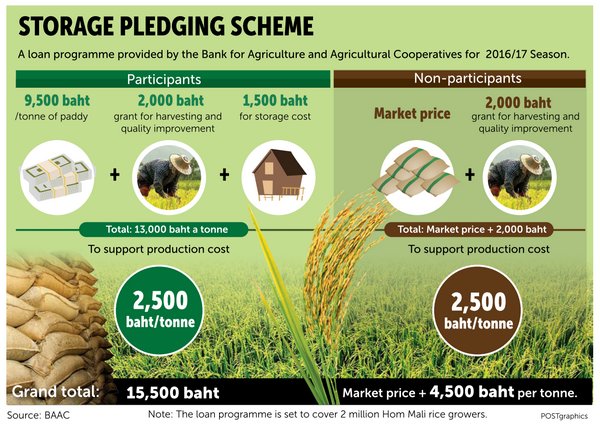
The Bangkok Post on November 8:'Prime Minister Prayut Chan-o-cha has called an urgent meeting with the National Rice Policy Committee to draw up relief measures for rice farmers before a new supply of grains hits the market this month....A source at the Agriculture and Agricultural Cooperatives Ministry said the meeting was prompted by the death of a Phichit rice farmer who allegedly committed suicide due to stress over heavy debts....The spokesman declined to respond to Pheu Thai politicians' criticism of the government's handling of the rice price fall, saying Gen Prayut urged restraint to avoid friction and told concerned authorities to focus on addressing the problems'.
'The National Rice Policy Committee agreed on Monday to launch a new subsidy scheme worth 18 billion baht to aid struggling farmers amid plunging rice prices'.But it doesn't seem enough. The Bangkok Post (Nov. 10):
'The regime's responses to plummeting rice prices have been both disappointing and disastrous to it and farmers. The worst came from government spokesman, Lt Gen Sansern Kaewkamnerd, who said a 43-year-old farmer in Phichit, who committed suicide because of debt caused by the price crisis, "was not a farmer, but an air-conditioner mechanic". It was a knee-jerk, unchecked and heartless response.
...It is obvious that Gen Prayut is taking cautious steps in implementing his subsidy scheme, which is, for many people, a model copied and pasted from many previous governments, including the Yingluck Shinawatra administration, and repackaged under a new brand....Amid the crisis, the regime was still critical of Ms Yingluck's "publicity stunt" of buying rice during meetings with farmers last week. Gen Prayut urged politicians to "stop exploiting the plight of farmers for political motives'.
Bangkok Post (Nov. 12):
'The free-fall in rice prices has sent an economic and political jolt across the country, and in the process highlighted how "thinking small" and modest-scale farming just might hold the key to the survival of farmers. The depressed rice prices, coupled with a growing demand for organic farm products, are driving the chemical-free rice sector and earning these growers more income'.
It's an interesting article which highlights how growing for the masses is past-tense; niche marketing is the future.
The Bangkok Post (Nov. 13) notes:
'Rice farmers have begged the government for help as their stockpiles, which were not bought last year because of oversupply, are backing up and leaving no room for this year's looming harvest.
...
Mr Nga urged the government to find ways to help farmers release their stockpiles so they can free-up space for this year's harvest. In tambon Muang Leang, 73 of 157 households joined the storage-pledging scheme for the 2015 harvesting season carried out by the Bank for Agriculture and Agricultural Cooperatives'.
What also highlights on the political importance of saving the rice farmers are the Bangkok Post opinions and editorials such as follows from November 6:
From November 19:'In the early 1980s, as a post-Vietnam war peace took shape in Southeast Asia, Thailand made an important decision. To be more correct, Thailand decided not to decide about rice.In purely logical terms, a la Mr Spock, it was time to shift the back-breaking burden of rice growing to poorer neighbours in order to move the economy along to modern development including advanced agriculture....The root cause is worldwide overproduction of rice. This is especially true and especially important in Thailand, the world's leading rice salesman.But the government for completely understandable political and populist reasons wants to ignore the "worldwide" part. If there is a world glut of rice, there's no way to blame profiteering rice millers and merchants....For the second time since the coup that sought to extinguish populism forever, Prime Minister Prayut Chan-o-cha had to reach into the government's money bags to address serious poverty among farmers.Like the problem with rubber growers, the premier really has no choice but a populist programme with two so-familiar aims: bail out the farmers in the short term and try to control the market in the long....Gen Prayut now is equally confident that if he locks up rice stocks -- new rice, at that -- the artificial shortage will raise prices. His contradiction, arguably even bigger than the Pheu Thai dichotomy, is that consumer prices are already high and aren't going lower. Ever. And if he thinks his soldiers can run rice mills and rice marketing, he's going to be disappointed, to say the least...Gen Prayut's rice problem has barely started. The ability of the state-owned Bank of Agriculture and Agricultural Cooperatives to finance another gigantic handout -- the scheme's estimated cost went from 35 billion to 127 billion baht in three days -- is debatable'.
From November 24:'The political bickering over how to help farmers suffering from low rice prices does not serve any purpose except exacerbating their hardship. Without a sincere halt to politicising rice prices, it is the rice farmers -- the very people everyone agrees deserve assistance -- who are destined to suffer the most....The current government can use input from rice farmers and researchers as well about its plan to introduce crop substitutes in areas deemed inappropriate for rice farming. Maize, the government's preferred choice for farmers in 35 central provinces instead of rice, is widely viewed as impracticable because the crop would not grow well in areas that used to be paddy fields'.
The author pleads for more farmer training.'With just about one year left in office, Prime Minister Prayut Chan-o-cha and his government will have to give a high priority to existing problems in agriculture -- especially the falling price of rice....A rice crisis always hits the government hard. Most of the measures introduced to tackle falling rice prices were not sustainable....However, none of these subsidies or cash handouts are long-term solutions. Farmers should be allowed to take the lead in empowering themselves'.
And on November 26:
Conclusions are that current strategies are once more aimed at influencing the market, though they seem more directed at garnering political support. The Thai political setting has always relied on even votes for the whole country. This has created an elite class which sees it's rule being challenged from urban centers, which have the voices but not the votes. So it's no wonder that whoever is at the helm of the country, political reform based on empowering urbanites, is not a notion to be considered.'When the government gave rice farmers 13,000 baht per tonne to shore up the all-time-low paddy prices, Boonsong Martthong and hundreds of organic rice farmers in Yasothon province just could not care less. Why should they? Why kowtow to the rice millers who give farmers only 7,000 baht per tonne of paddy or rejoice at the state subsidy scheme at 13,000 baht when they can already get 20,000 baht without a fuss. What's more, their polished organic rice easily gets 45,000 baht per tonne from health-conscious buyers.
...
According to Greennet, a non-profit organisation, the organic rice market has increased by 28% this year.
...
Despite state eulogies for the King, an advocate of organic farming, successive governments all strongly support chemical farming. The Agriculture Ministry has practically become the mouthpiece for agro giants -- and agricultural officials their salesmen. It comes as no surprise then that Thailand is among the world's top users of farm chemicals. According to the Agriculture Ministry, Thailand is importing an average of 160,000 tonnes of farm chemicals.
...
According to the Agriculture Ministry, Thailand is importing an average of 160,000 tonnes of farm chemicals a year, costing the country about 22 billion baht. In the past five years, the import of toxic farm substances has increased by 50% That makes Thailand the world's 5th biggest user of farm chemicals, according to the World Bank. The country's agricultural land area, however, ranks 48th in the world only. What's more, about 70 chemical pesticides used in Thailand are highly hazardous and not allowed in the West. The results? Most rivers and reservoirs in the country have become severely contaminated with toxic substances, which go directly to us consumers through the food chain.
...
The government is also pushing for farm zoning. "But this top-down policy won't work," Mr Boonsong insisted. "Farn officials don't know our localities. They don't have field experience. They don't have field experience. They don't have a support system either. What they can do expertly is telling us what farm chemicals to buy."
...
The problem, as always, is the gap between state's rhetoric for environmentally friendly agriculture and and its actions, the farmer said wearily'.
Finally to sum up the not so regional rice news section, the Vientiane Times (Nov. 25):
Others'Lao rice cooperatives have made good progress in terms of their rice production efforts but marketing and sales deficiencies are still causing problems for the co-ops'.
Well if rice is not moving what is? The Phnom Penh Post (Nov. 23):
'A local subsidiary of a South Korean confectionary giant is investing $40 million to develop what it claims will be the world’s largest pepper plantation on a sprawling 1,000-hectare estate in eastern Cambodia, a company executive said yesterday'.
Well, let's see what that would do for global and local pepper prices.
Mangoes should also have been on the radar of South Korea. However the Phnom Penh Post (Nov. 18) reports:
'It has been nearly a year since the government signed a memorandum of understanding with South Korea that aimed to put Cambodian mangoes on the shelves of supermarkets in Seoul, yet local producers say there is little sign of any movement.According to In Chayvan, president of the Kampong Speu Mango Association, the potentially lucrative trade agreement signed last December has stalled on South Korea’s stringent sanitary and phytosanitary (SPS) regulations, which local producers are unable to comply with....Chayvan said Cambodian mango growers would be better off focusing their efforts on securing export contracts for China, and upping shipments to the Thai and Vietnamese markets. He said these countries have less stringent SPS regulations, while Thailand and Vietnam are ready to bend the rules on SPS and certificates of origin when their domestic production is insufficient to meet demand....Mong Reththy, chairman of the agro-industrial conglomerate Mong Reththy Group, said his company has already shipped mangoes to Europe this year, and was looking forward to the possibility of exporting them to South Korea.However, he said, the Koreans take food safety very seriously and this has proven a stumbling block.“We are always looking to export to South Korea, but the issue is whether or not the government could meet their requirements,” he said'.
'Amid reports that Vietnam’s early harvest of cassava is facing downward price pressure, Cambodian farmers could be in for a rough season as local prices are largely dependent on those of the Kingdom’s more developed neighbour, a ministry official said yesterday....“Our experience with the cassava harvest from last year showed that most farmers lost money and around 40 percent of cassava producers have already given up on farming,” she said, adding that last year’s average selling price of 500 riel per kilo was below the 700-riel breakeven point.Heang [Sum Heang, head of the Pailin Cassava Association] added that she replaced 200 hectares of cassava with mango trees after losing $70,000 on the crop last year'.
In Thailand, alternatives are being sought for rice growing, even though it may not seem logic. The Bangkok Post (Nov. 16):
'The government's move to encourage farmers in 35 central provinces to grow maize instead of rice by giving them an interest rate subsidy is impracticable, according to a leading member of the provincial farmers assembly....“Over the past years, farmers had responded positively to government policies. They have grown maize, Crotalaria juncea [brown hemp or sunn hemp] or beans, but those crops did not grow well in soil suited for rice. Corn and beans did not give yields, and farmers suffered losses,’’ he said. The government should ascertain the views of farmers, or listen to their problems before implementing any policies, the Chai Nat farmers’ leader said'.
But also trying to fix the market is part of the Thai goverments strategy. The Bangkok Post (Nov. 9):
'Importers of wheat will be forced to purchase domestic maize as part of government measures to curb tumbling maize prices, under a cabinet decision'.
Bangkok Post (Nov. 25):
Meanwhile ..., the Bangkok Post (Nov. 6):'The government yesterday approved a three-year, tariff-free soybean import plan to ease domestic shortages on the condition that importers promote soybean farming and pay more for domestically grown soybeans'.
'The deputy governor of Phetchabun province has stepped up his campaign against potato contract farming in Thailand, urging consumers not to buy chips from the producer.
In the post, he referred to the report and expressed concerns about its impacts on the environment and how the company takes advantage of farmers'.


