Showing posts with label Indonesia. Show all posts

Saturday, March 3, 2018

Crude

Concerning Cambodian rice news, what surprises most is the source, the Khmer Times. However the news it reveals is less prone to surprise. 

First of all the Khmer Times (Feb. 27) reports :
'The price of Cambodian rice abroad has been on the rise since the beginning of February due to higher demand in China and the European Union, a representative of a local rice export company told Khmer Times'.
Basically it's following overall price increases on the globe. 

Then the news that the Cambodian government wants to assure it's customers. The Khmer Times (Feb. 15): 
'The Ministry of Commerce launched a new agency whose aim is to inspect the production and supply chain of rice branded as ‘made in Cambodia’ to guarantee its origin and provide assurance to foreign buyers.
With Cambodian rice having won multiple international awards for its quality, the move seeks to prevent the sale of foreign rice falsely claiming to hail from the kingdom.
The initiative is precautionary as, according to a ministry official, very few cases of ‘fake’ Cambodian rice have been reported to date'.
Finally, more interesting, an article from the Khmer Times (Feb. 23) concerning contract farming:
'Contract farming schemes in the kingdom work best under the centralised and the multipartite models, a study released yesterday by The NGO Forum on Cambodia revealed.
...
The study looks at contract farming schemes implemented by a group of agribusiness companies, including Amru Rice, Angkor Kasekam Roongroung, Confirel, Golden Rice, Lors Thmey, Cedac, East-West Seed, Entree Baitang, Mong Reththy and Natural Garden.
Researchers interviewed 70 small landholder farmers engaged in six different contract farming programmes, including contracting farming through agricultural communities and semi-formal contract rice farming.
Findings showed that “Contract farming can benefit both small landholder farmers and agribusiness companies the most when programmes are properly designed for a long-term relationship.
”It also concluded that even poorer, marginal farmers can take advantage of contract farming opportunities and that governmental policies that impact access to seeds and land rights are not sufficient to meet the needs of both small landholder farmers and agribusiness companies.
The study recommends the donor community to do more to encourage long-term, mutually beneficial contract farming programmes and to promote other engagement modalities between small landholder farmer and agribusiness companies'.
Lightheaded
Looking over the border the Bangkok Post (Feb. 9) also reflects on the nation's rice market conditions:
'Paddy prices for hom mali fragrant jasmine rice have surged to a five-year high, boosted by rising global demand.
According to Commerce Minister Sontirat Sontijirawong, purchase demand has led to a surge in paddy prices, particularly for hom mali paddy, whose price stands at 17,000-18,000 baht a tonne, the highest in five years and up from 9,500-11,600 baht a year ago.
"The ministry is upbeat that paddy prices will rise further, especially for hom mali rice, which is in high demand among rice exporters because of limited supply and depleted state stocks," Mr Mr Sontirat said. "The prospects of Thai white rice are likewise positive, thanks to higher purchase demand from foreign buyers and depleted state stocks."
He said overall rice exports look promising after Thailand shipped 1.2 million tonnes of milled rice worth US$578 million or an average $474.91 a tonne in January. Shipment volume rose by 16.5% from 1.03 million tones in the same month in 2017. The Commerce Ministry forecasts rice exports to stay at 9.5 million tonnes of milled rice this year, easing from a record high of 11.6 million tonnes in 2017'. 
The rise though of the local currency vis-à-vis the dollar may make Thai rice less competitive.

The Nation (Feb. 21) shows a vdo of what should have been an auspicious occasion: 



Accompanying text:
'The rice saplings that were thrown to mark an auspicious start to the government’s Thai Niyom scheme – which aims to diagnose people’s problems at a local level – were supposed to land in a rice field.
Instead, they accidentally landed on Prime Minister General Prayut Chan-o-cha’s head, prompting a lighter atmosphere amid the stress that has been building up on the government around the scheme, which some see as a political move by Prayut ahead of the election'.
In reality it's actually seen as another sign that the junta's time may well be up ... 

Power
A chapter for snippets. 

Away from the rice, the Phnom Penh Post (Jan. 31) reports on promised developments for the cashew sector:
'Cambodia and Vietnam signed an agreement earlier this month to greatly expand Cambodia’s cashew exports by 2028, but the proposed export level would require several hundred thousand hectares of additional land and there is no concrete plan yet to meet the target.
Cambodia’s Ministry of Agriculture and the Vietnamese Cashew Association (Vinacas) signed a memorandum of understanding (MoU) to increase Cambodia’s cashew exports to 1 million tonnes by 2028, up from the about 73,000 tonnes exported last year. Vinacas also gave the ministry a $66,000 grant to support the same target in December'.
Cassava is on the up. The Phnom Penh Post (Feb. 21): 
'The price of cassava jumped sharply this year as many farmers who were fed up with low profits for several years in a row changed crops, thus decreasing the market’s supply and raising the price.
Last year during cassava harvesting season – traditionally from December to April – the price for 1 kilogram of fresh cassava was about 108 riel, or $0.026, while this year it was up to 250 riel, according to Kim Hout, director of Battambang’s Provincial Commerce Department. The price of dried cassava was 715 riel per kilogram, up from 575 riel in 2017'.
The Bangkok Post (Feb. 25) on the kingdom's rubber throes: 
'Farmers have urged the government to help shore up the price of rubber by bartering with foreign countries for military equipment and vehicles'.
And an article by the Bangkok Post (Feb. 6) concerning how agricultural trade takes place in Thailand:
'Welcoming Prime Minister Prayut Chan-o-cha to her neighbourhood along the Chanthabun River yesterday, 58-year-old Siripataorn Thanaphurikiatkrai said she hopes the government will help lessen their dependence on merchants or middlemen who are predominantly foreigners, especially Chinese, and who usually have the power to set prices which sometimes are unfair to growers'. 
Blazed
Grain (Feb. 22) has an article on the golden rice developments which seem to be edging forward, a movement in which the hybrid rice industry draws hope that if regulated, then so will their products become acceptable.
'The recent release of Food Standards Australia New Zealand (FSANZ) approval report of International Rice Research Institute (IRRI) application for a Golden Rice ‘safety stamp’ and trade liability clearance have garnered negative reactions and widespread critique.
Testbiotech, a non-profit organization founded as an Institute for the Independent Impact Assessment of Biotechnology in 2008 in Munich, Germany concluded that the “application does not show substantial benefits. Furthermore, the risk assessment as performed by FZANZ is not sufficient to demonstrate safety of food derived from GR2 (Golden Rice 2).” Aside from expounding on the questions of nutritional viability and genetic stability of Golden Rice, Testbiotech also criticized lack of toxicological studies, exclaiming that “…it is self evident that food products with no history of safe use must be subjected to highest standards of risk assessment before the most vunerable groups of the population are exposed to it…”
Civil society in Australia and New Zealand also challenged the soundness of FSANZ decision and appealed to review its approval'.
Continuing with big money issues, the Guardian (Feb. 27) reports on action in Sumatra concerning oil palm expansion:
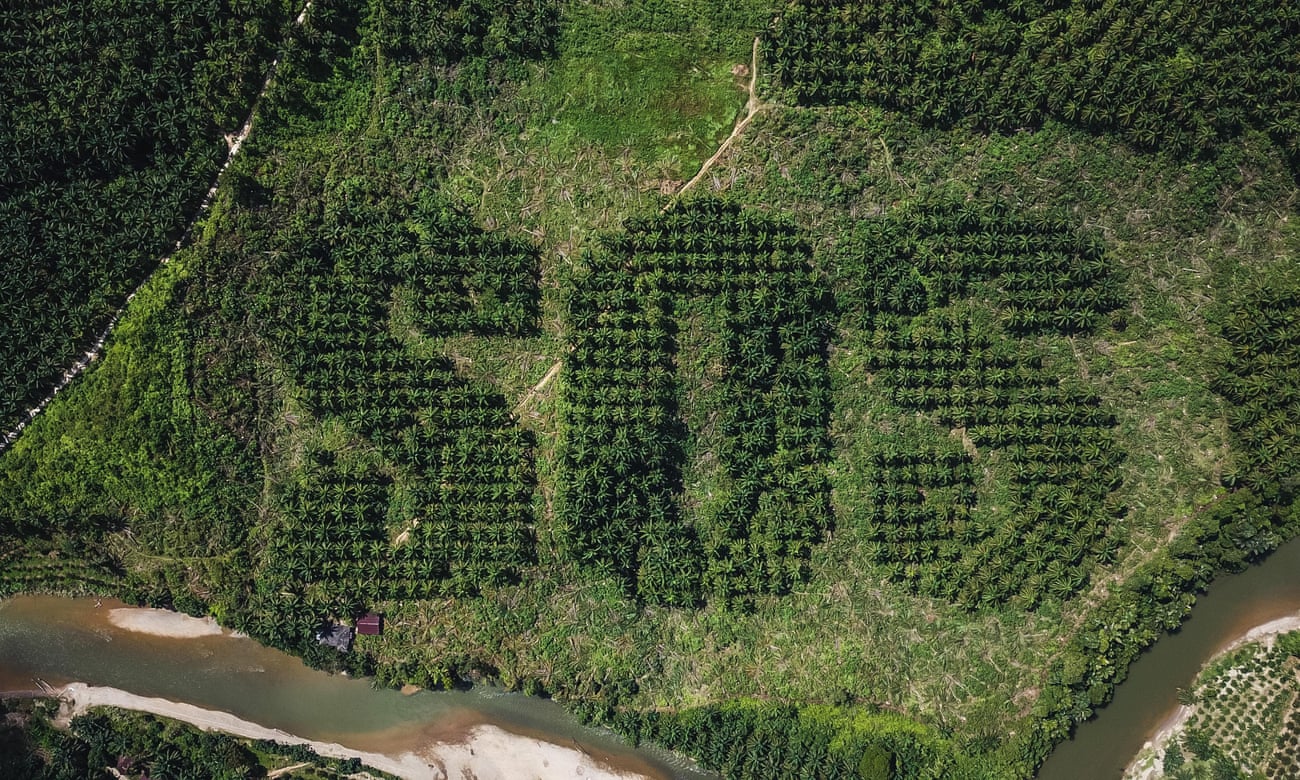
'Dramatically carved into the landscape of a Sumatran oil palm plantation that borders one of the world’s most unique rainforests are three ominous letters: SOS.
The message stretches half a kilometre alongside a snaking river; a bird’s-eye view gives the eerie sense the land has been given voice, and is issuing a mayday.
“From the ground, you would not suspect anything more than just another palm oil plantation. The aerial view, however, reveals the SOS distress signal,” says the Lithuanian artist Ernest Zacharevic. For a week Zacharevic has been carefully plotting his concept out tree by tree – or oil palm by oil palm – all 1,100 that were cut down to etch out the message.
The work in Bukit Mas, Sumatra, is intended to convey a pressing distress signal, drawing attention to the ongoing destruction of Indonesia’s rainforests and the critically endangered species, such as the Sumatran orangutan, that reside within it.
...
This year the artist has collaborated with the Sumatran Orangutan Society (SOS), which, together with the cosmetics company Lush, raised the funds to buy the 50-hectare (124-acre) oil palm plantation with the intention of reforesting it entirely.
Before the oil palms are replaced with tens of thousands of native seedlings, Zacharevic was offered the chance to bring his idea to life.SOS’s director, Helen Buckland, was on site as the art project was under way and cheered as the oil palms were felled'.
Interesting to see, that despite all the negatives surrounding palm oil plantations in Southeast Asia, it's hard to convince policy makers that the route taken needs to take a different direction. 

It's very well illustrated in the documentary Green Gold, which I viewed recently. 
Europe's response to the oil crisis has been to advocate oil substitutes such that even these have become big business with the gross misconduct concerned with large players. 

Even on small scale this has it's imitators. 
Mongabay (Mar. 1) describes how on Borneo even local politicians are setting up companies for relatives awarding these with the necessary permits after which the companies are then sold to larger companies, all at the expense of local communities / environment.

What Green Gold perfectly portrays, is how when the bigger companies smell money to be made, there's precious little that can stand between them and their profits. Energycollective (Nov. 20):
'Ghizzardi recounts the case of UPM, the Finnish paper company that discovered biofuels on a hunt for new products to make up for falling paper sales. It started making biodiesel from crude tall oil (CTO), a by-product of pulping pine trees. The result? A furious chemicals sector coming out with guns blazing to protect what it regards as one of its own raw materials'.
Profit seeking behemoths are dictating our future rather than ourselves.

Saturday, January 27, 2018

Interesting

It's the start of the year, when Cambodia sees it's big bosses discuss rice. No difference there, this year. 
Probably the most significant snippet from the meet is the announcement of a national rice brand. The Khmer Times (Jan. 22):
'The annual rice forum starts in Phnom Penh today, bringing together farmers, businesses and researchers for a two-day event that seeks to find solutions to some of the sector’s most pressing questions.
...
Malys Angkor, the first brand name of Cambodian premium rice, will be formally launched during the event'.
Even the Bangkok Post (Jan. 24) chimes in:
'Rice authorities unveiled the “Malys Angkor” rice brand, a new certification mark that encompasses a range of Cambodian fragrant rice varieties'.
The Phnom Penh Post (Jan. 22) delves deeper into the issues of the single brand and more urgent problems as unveiled at the meeting:
'The Cambodia Rice Federation (CRF) today announced a new “Malys Angkor” brand to be used as the official moniker for four species of Cambodian fragrant rice.
The first day of the two-day Cambodia Rice Forum also featured the release of a remarkably frank report on the industry group’s internal issues, which acknowledges that the CRF’s numerous flaws are currently preventing it from acting as a proper representative of the country’s rice sector.
Sok Puthyvuth, president of the CRF and son-in-law of Prime Minister Hun Sen, lauded the branding effort at the launch of the forum at Phnom Penh’s Sofitel Hotel today.
...
The Malys Angkor branding push is part of the CRF’s long-term goal to promote the country’s rice sector, but those efforts are being hampered by significant internal problems, according to the group’s “Strategic Plan 2017-2021”.
“Current assessments suggest that there are many challenges facing the CRF,” the report says, noting that board members appear to have “commitment discipline issues” and that many board members only attend meetings “when the meeting is about their interests”.
Other complaints include farmers being pushed aside in favor of millers and traders, as well as more wealthy or connected members having greater access to the CRF’s services and attention than regular members.
Money also appears to be a problem, as “lack of sufficient financing” and few technical experts results in the CRF lacking a way of “sustainably handling requests from of [sic] members of the rice sector.”
In addition, board decisions “often remain unimplemented”, and a new scheme to increase local-level monitoring of the rice sector by placing CRF representatives in various zones around the country may run into trouble because “the CRF appears to not possess all the requirements” to implement the program'.
So, despite the hoopla concerning the single brand it seems the rice sector is more based on lining each participants pocket(s) as she/he wishes. Nothing new to the current Khmer climate, where it seems that there's only one party in town. Literally.

As if the single brand isn't sufficient the Khmer Times (Jan. 23) notes that there's also a focus on having a GI within the brand:
'Rice authorities in the kingdom are exploring the possibility of applying for Geographical Indication (GI) status for rice grown in areas around the Tonle Sap Lake.
Speaking during the Rice Forum in Phnom Penh, Sok Puthyvuth, president of the Cambodia Rice Federation (CRF), said his association will present a proposal to the Ministry of Commerce to consider awarding GI status to rice grown in Siem Reap, Kampong Thom, Kampong Chhnang, Pursat and Battambang, the provinces that surround the Tonle Sap.
Mr Puthyvuth said that creating a brand name for rice grown in areas around the Tonle Sap will make for a sound marketing strategy, helping increase demand for the product in European markets'.
Is this not complicating things?

Ups
Then there's the stocktaking of 2017. The Phnom Penh Post (Jan. 2) notes the numbers are up:
'Cambodian rice exports in 2017 increased 17 percent by volume compared to the year before, with exporters pushing to fill orders under China’s expanded import quota while shipments to European markets remained steady, according to Agriculture Ministry figures.
A total of 635,600 tonnes of rice was exported to international markets in 2017, up from 542,144 tonnes the previous year, according to a Facebook post by Hean Vanhan, director general of the general directorate of agriculture at the ministry.
China, which agreed to accept 200,000 tonnes of rice from Cambodia in 2017 – doubling the previous limit – and will expand the quota to 300,000 tonnes this year, was the top destination for rice shipments.
Over five years, total rice exports have grown 67.78 percent from 378,800 tonnes in 2013, the figures show'.
But are the returns in money terms also as positive? And what is the actual price being paid for becoming more and more dependent on the Chinese market?

The Bangkok Post (Dec. 29) jots down the Thai story of rice over 2017. Quite similar:
'Rice exports hit an all-time record in 2017, increasing by 14.77% this year to at least 11.25 million tonnes as of Dec 27, the Ministry of Commerce said. The price per tonne has risen above US1,000 for popular Jasmin fragrant rice, or hom mali'. 
The Phnom Penh Post (Jan. 10) looks at the government loan scheme. To big business mainly:
The government has provided $30 million in loans to rice millers since September to facilitate the purchase of paddy rice, with the head of a state-run bank saying more money was available if necessary.
The loans were issued to 38 rice millers by the state-owned Rural Development Bank (RDB) following September’s rice harvest, and would need to be paid back by April this year, according to RDB’s CEO Kao Thach'.
A lesser bit of national rice news, but more encouraging. The Khmer Times (Dec. 28) reports on how the Ibis Rice project has been successfully expanded to Stung Treng province.

Seething
Major news from the massive palmoil sector in the region, touching on one potential for Cambodia's ag sector. 

Hoping to cash in on the ill-ventured biofuel programmes (I mean you need more fuel to grow the crops than you receive after harvest) the boom may well be leading to a bust. 
Despite warnings, palmoil plantations have done little to ensure a decent level of sustainability. And no surprise then, that the EU will be discontinuing the palmoil component within the regions biofuel programme. Euractiv (Jan. 17):
'The European Parliament decided today (17 January) to phase-out palm oil by 2021 and cap crop-based biofuels at the member states’ 2017 consumption levels and no more than 7% of all transport fuels until 2030....“The Parliament has sent a message that not all biofuels are created equal by focusing on getting rid of those that drive deforestation like palm oil. But its amendments still risk making it harder for EU member states to realistically boost renewables in transport,” Secretary-General of ePURE Emmanuel Desplechin said'.
The decision has especially Malaysia and Indonesia up in arms, both crying foul play. Mongabay (Jan. 19):
'Officials in Indonesia and Malaysia, the world’s biggest producers of palm oil, have lambasted the European Parliament’s decision to phase out the commodity from motor fuels over the next three years due to environmental concerns.
Indonesian Trade Minister Enggartiasto Lukita said Thursday that the vote to reduce to zero “the contribution from biofuels and bioliquids produced from palm oil” by 2021 was misguided and unfair, given that Jakarta had taken steps to address the environmental impact of the palm oil industry.
The trade minister’s remarks came a day after the European Parliament voted on targets to cap crop-based biofuels, which follows the parliament’s overwhelming decision last year to ban the use of vegetable oils in biofuels. The amendments will now go to the European Commission and member states before they become law.
The move will have serious ramifications for Indonesia and Malaysia, who together produce nearly 90 percent of the world’s palm oil.
...
While the governments seethe, conservation and indigenous rights activists have welcomed the phase-out vote, citing the massive toll the palm oil industry has taken on tropical rainforests and the local communities dependent on them.
Eep Saefulloh, a researcher with Sawit Watch, an NGO that monitors the palm oil industry in Indonesia, criticized the industry talking points that the deforestation caused was legally sanctioned.
“If we’re talking about large palm oil plantations, of course they cause deforestation,” he said. “Unless we’re talking about small farmers only need a hectare or two. But if we’re talking about large plantations that can extend beyond villages and districts, what do we call that if not deforestation?”
This news takes some time to seep through to Cambodia. The Phnom Penh Post (Jan. 24):
'New proposed rules from the European Union restricting the import of palm oil would likely affect Cambodia’s nascent palm oil sector, but the country’s main exporter is hoping that demand from India and China will cushion the blow.
Cambodia’s palm oil exports rose by a whopping 143 percent last year, according to Ker Monthivuth, a sanitation expert at the Ministry of Agriculture. The country exported more than 44,000 tonnes of crude palm oil in 2017, up from nearly 19,000 tonnes the year before, he said.
...
“We will look to what happen in India and China, if they increase [consumption] volume,” he [Prachak Kongtanomtham, vice president of sales and marketing at the Mong Reththy Investment Cambodia Oil Palm Co Ltd] said. “We should find how can reduce our production cost, especially logistic cost and utility,” he added, noting that costs were “very high” in Cambodia'. 
Flied
From the kingdom's fruit front, it's mostly mango making the moves. The Phnom Penh Post (Jan. 22) looks at the export of  the fresh produce:
'Cambodia’s mango shipments have been routinely blocked before making it to the international market, with the Ministry of Agriculture claiming the mangoes are not of a high enough quality to meet the sanitary and phytosanitary (SPS) requirements necessary to ship outside of the Kingdom.
According to Hean Vanhan, director general at the General Directorate of Agriculture, the main obstacle for Cambodian mangoes making it to the international market has been the prevalence of fruit flies, which infest prospective shipments of the produce.
“It is not a matter of the quality of our mango – the main obstacle to the market is the fruit fly, which blocks our mango exports and makes it difficult to achieve SPS certification,” he said, adding that the SPS certificate could only be granted to shipments of mangoes devoid of “injurious pests”.
...
In Chayvan, president of Kampong Speu Mangoes Association, said that while the fruit fly has been a problem for mango farmers in the past, most have established methods that ensure there are few to no flies in their mango shipments.
The real reason Cambodia’s mangoes are unable to reach the international market, he said, is because they are often blocked for perceived hygiene-related issues, and he urged the Ministry of Agriculture to hasten its administration of SPS certificates to encourage neighbouring countries to buy Cambodian produce.
“The fruit fly is not our main concern when it comes to being blocked from the international market,” he said, adding that most mango shipments that had been prepared to leave Cambodia had met the SPS requirements. “Our main issue is that the SPS certification is too hard to get from the ministry, and so we have no access to ship to surrounding countries.”
But on the upswing, the same source (Phnom Penh Post, Jan. 4) notes positives for the export of dried mangoes:
'Phillipines-based dried fruit exporter Profood International has begun construction of a new factory in Cambodia that, when completed, should see 4,000 tonnes of mangoes dried annually, according to Philippine news outlet Sun Star.
Justin Uy, Profood founder and president, told Sun Star the 11-hectare plant was expected to begin operations in 2019, and that all mangoes dried at the facility would be slated for shipment to the Chinese market to satiate the nation’s annual 30,000 tonne demand. The company’s entry into Cambodia is intended to strengthen its foothold in the Southeast Asian market. Profood products are sold in 52 countries'.
And now something totally unrelated, but I think it's relevant to this blog. It has  very little common with all the other subjects explored this time round, but I still feel I need to explain. Anyway the Vientiane Times (Jan. 24) reports:
'Chemical and pesticide experts from Laos and other Asean member countries are meeting in Vientiane this week to discuss the harmonisation of maximum pesticide residue limits in the interests of food safety.
...
So far Laos has adopted 768 out of 808 Asean maximum residue limits but lags behind many Asean member states in this regard'.
Boom to bust
Contrasting news.
From Cambodia (Phnom Penh Post, Jan. 18) on the increasing expansion of rubber cultivation, though with a side note on smuggling to Vietnam. Beats me , why Cambodian producers would need to pay an export tax, totally uneconomic.
'The total amount of rubber exported by Cambodia surged 30 percent last year, but widespread rubber smuggling on the Vietnamese border crippled potential profits from the booming industry.
Cambodia generated about $300 million in revenue by exporting nearly 189,000 tons of rubber last year, according to Pol Sopha, general director of the rubber department at the Ministry of Agriculture. The revenue boost was also helped by a 24 percent increase in the average price per ton, which was up to $1,586 last year, compared to $1,283 in 2016.
But while small-scale rubber farmers were able to sell their crops for a profit, the industry as a whole was crippled by massive smuggling operations that shipped much of the country’s rubber into Vietnam tax-free, according to Sopha'.
But over in Thailand, there's more focus on the low prices. The Bangkok Post (Jan. 6):
'Rubber prices are expected to rise to 60 baht a kilogramme in the first quarter after Thailand, Indonesia and Malaysia pledged to withhold exports of 350,000 tonnes of natural rubber (NR) from this month until March.
...
Thai natural rubber prices have been falling for several years, largely due to oversupply from major rubber-producing countries. The weak global economy subsequently cut demand in the auto industry, damaging rubber producers as a result.
The drop was also attributed to the growth of rubber plantations in Cambodia, Laos, Myanmar and Vietnam in the past 10 years. The CLMV countries currently supply 5.3% of the commodity to the global rubber market'. 
Seeing the pie has not increased, the new entrants are claiming a share, but Thailand seems reluctant. A solution put forward was to allow large scale investment (read take-over) in the Thai rubber sector by China. But the Bangkok Post (Jan. 7) reports on the distrust issue:
'China's plan to invest in rubber plantations in Thailand must be carefully considered, says Grisada Boonrach, minister to the Ministry of Agriculture and Cooperatives, but such projects must not impact local farmers. His comment was made in response to a report that China Hainan Rubber Industry Group is set to invest more in rubber plantations in the country, as it has done recently in the CLMV countries (Cambodia, Laos, Myanmar and Vietnam). Under these schemes, Chinese nationals oversee rubber production on land leased by the company.
...
Mr Grisada said that as the issue is quite sensitive a thorough study must be undertaken to ascertain the impact on domestic producers. His major worry being that there might be a repeat of the price dumping by Chinese middlemen in fruit markets in the eastern provinces'. 
Then it's reported (Bangkok Post, January 24), that producers will still try to keep the prices reasonable:
'Thailand, Malaysia and Indonesia are hopeful of seeing the end of sagging natural rubber prices after agreeing on export cutbacks, Agriculture Minister Grisada Boonrach said.
The minister expressed Thailand, Malaysia and Indonesia are hopeful of seeing the end of sagging natural rubber prices after agreeing on export cutbacks, Agriculture Minister Grisada Boonrach said. The minister expressed confidence about the turnaround of rubber prices following the implementation of the three countries in the International Tripartite Rubber Council to curb exports for three months starting from Jan 10'.
Sugar
The great sell-off in practice. 
The Khmer Times (Jan. 12) notes how Cambodia is counting on China to take some sugar:
'During a meeting with Chinese Premier Li Keqiang yesterday, Prime Minister Hun Sen asked China to increase imports of Cambodian sugarcane.
...
The kingdom imports between 500,000 to 600,000 tonnes of sugarcane every year, according to a representative of Phnom Penh Sugar.
However, only 100,000 to 150,000 tonnes are absorbed by the local market, with the remaining sugarcane being re-exported.
During the meeting yesterday, Mr Li agreed to increase their quota for imports of Cambodian milled rice, from 200,000 tonnes to 300, 000.
During the opening of the LMC summit on Wednesday, Mr Hun Sen also encouraged China to purchase more Cambodian cassava.
Umm, the sugar isn't even Khmer.

Bangkok Post (Jan. 17) describes the measures taken to meet WTO rulings:
'The government has invoked Section 44 to float the local price of sugar, says Industry Minister Uttama Savanayana. The local price had been subsidised by the Thai government. But the government wants the local price to be on a par with the global rate, as its support was in violation of a World Trade Organization (WTO) rule, with other sugar producers such as Brazil crying foul.
The plan to float the sugar price had been postponed since Dec 1'. 
The idea is not to raise local prices, but to hope that world prices will drop to Thai domestic levels. Thus face saved.

Inclination
A few snippets concerning growing cassava. The Khmer Times (Jan. 11):
'Agriculture Minister Veng Sakhon met on Monday with visiting US professors W. Ronnie Coffman and Max J. Pfeffer from Cornell University to discuss cooperation in a new project whose purpose is to yield disease-resilient, high yielding cassava.
...
CARDI director Ouk Makara, who also joined the meeting, told Khmer Times that the team of US professors use biotechnology [genomic selection] to cultivate their cassava variety.
“The next generation cassava yields 10 percent more than our cassava,” he said, adding that, on average, Cambodian cassava yields 24 to 25 tonnes per hectare.
Cassava plantations in the kingdom have increased from 30,000 hectares in 2005 to 684,070 in 2016, with total production amounting to 14.8 million tonnes last year, according to data from the Ministry of Agriculture.
The provinces in which the crop is grown are Battambang, Banteay Meanchey, Pailin, Kratie, Kampong Thom, Tboung Khmom and Oddar Meanchey.
Cambodia exported 2.3 million tonnes of cassava chips during the first nine months of 2017. Cassava chip exports in 2016 amounted to 2.9 million tonnes, which mostly went to China, Thailand and Vietnam'.
Is genomic selection just a short cut for natural selection?

The Vientiane Times (Jan. 15) finally shows us an example of how business should not take place:
'Many of the nation’s cassava farmers remain desperate to recover money that the Lao-Indochina Group Public Company has owed them since failing to pay for their produce in 2012.
The company’s bankruptcy resulted in the firm’s creditors, mostly cassava farmers, incurring further debts to banks, notably Nayoby Bank, leading the situation to its current deadlock.
...
The company ran up debts of 17.5 billion kip to cassava growers five years ago when it got into financial difficulties.
Only 4 billion kip of the total has been repaid to date.
In Vientiane’s Pakngum district alone, farmers sold 21 million tonnes of cassava worth almost 963 million kip to the company for processing at its tapioca factory in the district.
...
Cassava cultivation in Pakngum district is now fairly subdued.
Many farmers are disinclined to grow the crop because they are still indebted to banks as a result of their predicament.
This year, some farmers planted cassava, but in smaller quantities than in previous years with dried cassava then sold to Vietnamese traders.
Farmers want to know when they will get paid for all the cassava they grew and gave to the factory several years ago.
Many still owe money to district banks after borrowing to clear their land and plant cassava. Most of the farmers in question are now growing other crops, while some are pursuing other livelihoods'.

Saturday, January 30, 2016

Helpful clarification

I would have wanted to start this blog off with a look into all the possible GMO interventions which, increasingly, are becoming more like traditional crop improvement but just a little faster in it's outcome. It certainly is obscuring the discussion. But there's not really that much out there to give an informed answer to this.

What is sure though, that every company-lead intervention focuses on private profits rather than providing a public good. So there's always going to a healthy case against whatever is suggested. 

But for the moment let's just see if this will remain and keep attuned to whatever changes lie ahead.

Ignore
Properly the most important news from the Cambodian rice front was a visit and speech  from the Cambodian PM to the Cambodian Rice Forum. From the Cambodia Daily (Jan. 25):
'Speaking to industry bigwigs at the annual Cambodia Rice Forum at the Sokha hotel in Phnom Penh, Mr. Hun Sen [PM] lauded efforts to in­crease the profile of Cambodian rice abroad, but noted that stiff re­gional competition had limited the country’s export totals.
...
Eang Heang, owner of the Eang Heang Rice Mill Factory in Battam­bang City, said his inability to ac­cess an affordable supply of electricity was hindering production.
“We don’t have state-supplied elec­tricity,” Mr. Heang said, noting that his milling factory was forced to run on a generator, as Electricite du Cambodge had yet to connect it to the main grid'.
As always the problems facing exporting of Cambodia rice are limitless.  
Take for instance the currency of trade. The Khmer Times (Jan. 10): 
'As China’s currency, the yuan, falls against the US dollar and other major global currencies, Cambodian rice exporters say they will need to adjust their prices to compete in the market they have targeted for expansion.
Hun Lak, vice president of the Cambodia Rice Federation [CRF], said prices of rice exports to China will need to fall due to yuan’s depreciation, which began at the end of last year. “Thailand and Myanmar lowered their rice prices and if we don’t follow suit we cannot sell our product [in China],” Mr. Lak said.
“Fragrant rice was priced at $740 per ton on average [in China] at the end of 2015, compared to around $800 early in the year and white rice is going for $430 per ton, about $20 to $30 lower,” Mr. Lak said, noting that pricing is in US dollars'.
In the same vein, the Khmer Times (Jan. 19) reveals that the Cambodia will actually focus on exporting agricultural produce:
'The Agriculture Ministry yesterday launched a strategy for the developing the sector, aiming to expand exports of agricultural products to spur economic growth through sustainable farming practices'.
No irony is lost on the government's role, as it has actually been hindering exports ... Continuing:
'Song Saran, president of Amru Rice Cambodia, said that although it was good to have a strategic plan to develop agriculture in Cambodia, the plan is already out dated because the focus should be on rice production. Rice production and export needs to be addressed urgently, Mr. Saran said.
The government should fast-track railway rehabilitation to reduce transportation costs, lower electricity costs, offer low interest loans to the rice sector, build more storage facilities and invest in ports to ensure that Cambodian rice is competitive in export markets'.
What about the CRF itself? The Phnom Penh Post (PPP) on Jan. 13:
'The Cambodia Rice Federation (CRF), the apex body of the nation’s rice industry, is looking to bring all relevant stakeholders under one unifying vision for the sector, citing the lack of cooperation among its members as a key reason for missing last year’s 1 million-tonne milled rice export target.
...
One of the biggest challenges faced by the federation, according to Lak [CRF vice president], was managing the country’s supply and demand of rice paddy. He cited instances where millers could not purchase paddy given that the farmers desperate for cash had already sold it to millers in neighbouring countries.
To remedy this scenario and achieve the export target of 1 million tonnes of milled rice per year, Lak said the federation’s members would need about $550 million for paddy procurement'.
Again a case of trying to control the market. Better would be an export board which focuses solely on exporting the product.

A side no
te on the direct challenges ahead. The PPP (Dec. 25) reports on an issuance from the government warning farmers off a dry season rice crop:
'Farmers and exporters have expressed concerns over an Agriculture Ministry notice issued on Wednesday asking farmers to have only one harvest this upcoming dry season because of water shortages across the country, given that this could affect the paddy output next year'.
With very few alternatives given.

Organic rice news. The PPP (Dec. 30):
'Cambodian rice millers and exporters are increasingly eyeing the export of organic rice to the European Union and the United States, after shipments of this niche product increased this year.
...
Amru Rice, one of the major rice exporters in Cambodia, started exporting organic rice this year and has so far shipped 1,100 tonnes to the EU and US. It sees potential in this new market, according to the firm’s CEO Song Saran'.
From the VoA (Jan. 26) this revealing article on the state of ignorance on organics:
'Cambodian agricultural experts are suggesting a national standard for organic products.
Cambodian farmers are increasingly growing organic rice and vegetables in some places, but there is no official certification available.
Officials at an annual conference held by the Center for Study and Development in Agriculture, or Cedac, say such a standard would increase the market value of organic products, helping diversify the agricultural market and would also prevent the spread of fake organic products.
...
Hean Vanhorn, director of the agricultural department at the Ministry of Agriculture, said the ministry is currently focused on a wider program called “good agricultural practice,” to increase yields, rather than organics. The development sector pushes for organics, he said, but they don’t provide as much benefit as GAP, he said.
GAP products aren’t harmful, he said, “so why do we need to resort to organic products that aren’t really scientific and not as accurate as GAP?” GAP ensures that food is safe to eat, he said. “What else should we be looking for?”
Finally some investment news. The Khmer Times (Jan. 2):
'Three of China’s major companies are planning to invest some US$400 million in the construction and operation of a state rice warehouse project in Battambang, Pursat and Kampong Thom provinces'.
Also reported by the PPP: 
'Given that Battambang, and other neighbouring provinces like Pursat and Banteay Meanchey account for a third of the country’s paddy output, the new warehouses were welcomed by Kann Kunthy, CEO of rice miller Brico.
However, Kunthy said it would be more useful if the warehouse were equipped with drying facilities, which would mean that fresh paddy could be dried and stored for a long period of time'.
Weather
Reuters (Dec. 25) expresses it's doubts on the Thai policy of emptying their warehouses a.s.a.p.:
'Thailand's military government will struggle to offload by a 2017 deadline some 14 million tonnes of rice in state warehouses left over from a policy of the civilian government it ousted, traders and exporters said.
...
"I don't think it's possible, but even if it is, offloading that much rice within a short time will have a negative effect on market prices," said Supachai Vorraapinyaporn, president of Tanasan Rice Group, Thailand's third-biggest rice exporter.
"It will also encourage bidders to delay bids and wait to purchase rice at even lower prices in the next auctions."
One way Thailand hopes to sell more is through government channels (Bangkok Post, Jan. 6):
'The Thai government aims to sell over 2 million tonnes of rice this year on a government-to-government (G-to-G) basis. But it admits a renewed attempt to sell rice to Iran may hit a snag because of escalating political conflict in the Middle East'. 
However there are others which would like to see the stored rice rather sooner than later. The Bangkok Post echoes (Jan. 18) business sentiments asking for the government to speed up exports (from stored rice). There seems no logic behind this call as all it seems is to expand trade at all costs, though more exports will mean lower prices so not necessarily more money ....
 
Despite previous assertions to the contrary, officials believe that the major rice growing areas will not suffer from drought during the first  months of this year (Bangkok Post, Jan. 11):
'But irrigation chief Suthep Noipairote predicted drought would not ravage the Chao Phraya plain as the rice bowl of the country will have enough water until the end of May'.
The Nation (Jan. 19) reports on government attempts to suppress production:
'Rice Farmers and traders have supported the government’s plan to reduce rice production to 25 million tonnes of paddy this year in the hope it will lead to the industry’s sustainable development and long-lasting stable prices.
Thai Agriculturalists Association president Suthep Kongmark said rice farmers had agreed to cut rice production by about 5 million tonnes this year.
The move followed a meeting of the Commerce Ministry's working committee to formulate a national rice strategy.
Despite the decision to cut production, rice farmers still expect the government to provide clear-cut measures to support farmers in the cultivation of other economic crops in a bid to reduce the hit from the drought'.
And despite this plan, I doubt it will work, as individual farmers will not participate ...
 

VoA (Jan. 20) reckons that it's not the government that will see Thai farmers through the upcoming crisis, but their own resilience :
'But growers hope to weather the hard times by drawing on years of farming experience and hopes of a revival in rice prices'. 
However the article has precious little proof that this just might happen ...

Bangkok Post notes that the future may be a little bleaker for exporters (Jan. 28):
'Rice exports are expected to have another difficult year as the world market is likely to be volatile amid foreign exchange and oil price risks, according to exporters'.
Then again the Nation (28 Jan.) leads us to believe that less production due to drought will mean higher world prices thus more export:
The Thai Rice Exporters Association (TREA) announced yesterday that Thailand should be able to export between 9.5 million and 10 million tonnes of rice this year, as drought has increased demand in many countries, while Thailand has plenty of rice stocks. TREA president Charoen Laothamatas said Thailand should be able to export at least 9.5 million tonnes of rice worth not less than US$4.77 billion (Bt165 billion). "The drought will encourage higher rice prices in the world market and domestically amid higher demand amid lower production in Thailand and many countries. In Thailand alone, rice output is expected drop by 15-20 per cent or about 2 million to 3 million tonnes from the drought," he said.
No word though on what it means for farmers themselves ....

Plans
Some more rice (trade) news from the region. 
The Vientiane Times (Jan 22) notes private initiatives:
'Phanphet Agriculture Development Farm (PADF) is preparing to sell 10,000 tonnes of rice this year after negotiating exports with international partners'.
Meanwhile Radio Free Asia reports (Jan. 24) that the Lao rice production has been a little disappointing.
'Laos’s rice production has fallen short of government targets for the second year running due to natural disasters and a seed shortage, dealing a potential blow to the Southeast Asian nation’s ambition of becoming a rice exporter.
It produced 2.70 million tons of rice in 2012, 10,000 tons short of the official goal, according to official figures'.
Only 10,000? How is that newsworthy?
The wish list of Vietnam's government (vietnam.net, Jan. 12):
'The agricultural sector plans to slash rice cultivation by 100,000 hectares in 2016 to grow other grains used to feed animals, said Minister of Agriculture and Rural Development Cao Duc Phat.  
About 7.6-7.7 million hectares of land will be set aside for rice cultivation with a total yield of 44.5 million tonnes, he stated, highlighting that the sector will enhance quality while reducing costs of rice production by using high-quality varieties with high value and applying comprehensive cultivating methods'. 
And what if the plan economy does not exist anymore?
Vietnam is worried about Thailand's bargain sale. Of course. Vientnam.net (Jan. 21):
'Huynh The Nang, chair of the Vietnam Food Association (VFA), said in the Vietnam News Agency that the sale of Thai rice would force the market price down, thus badly affecting Vietnam’s exports'.
An interesting article from Anatara (Jan. 16) on how Indonesia uses imported rice solely to cushion domestic price increases and to use in case of potential domestic shortfalls in production. Wonder why this is not done on a global scale ...

Reverse gear
In the past we have looked at some of problems rubber farmers in especially Thailand have met with and how they would like to see their problems resolved. 
And their problems are the low and lessening prices with little prospect for a change
Farmers look to the government to resolve their problem. The government (read junta) want to look strong and thus not willing to oblige.

Let's start with a background article from the Bangkok Post (Dec. 30) on the rubber glut:
'Global demand for natural rubber, used mostly in tyres, is slowing as the economy cools in China, the world's largest buyer of new cars. Supplies are expanding after a decade-long rally in prices to a record in 2011 encouraged top producers like Thailand, Indonesia and Vietnam to plant more trees. Output will exceed use for two more years, with the surplus quadrupling in 2016, according to The Rubber Economist Ltd, a London-based industry researcher.
...
In Thailand, the local price of rubber sheet has plunged to about 37 baht a kilogramme from an average of 56 baht last year and 76 baht in 2013, according to the Rubber Authority of Thailand. The average cost of production is around 65 baht, the farm ministry estimates.
...
"For price recovery, we need to see a significant reduction in supply or a strong growth in demand," said Macquarie's Ms Kovalska. "We're unlikely to see any of that anytime soon."
Then the Bangkok Post (Jan. 7):
'Rubber planters have threatened to protest after prices plummeted to the lowest level in 10 years, saying some of them no longer afford to send their children to school. Prime Minister Prayut Chan-o-cha vowed to stand firm against the growers' growing pressure'.
Some of the demands by farmers were becoming political.

The Natio
n continues (Jan. 8):
'Rubber farmers in Trang province are threatening to go on a hunger strike if the government continues to ignore their plight'.
Their other solution is to ban rubber tapping and compensate the tappers.  
The article also notes how the government is mostly ignorant of the situation and seems not to tolerate discussion of their policies.

Bangkok Post (Jan. 9) headlines that the PM will rule out rubber price subsidy. It also notes that 
'... demonstrations are illegal'. 
Interesting to read in the comments that the government in the past (as recent as 2010) had put money down to encourage farmers to grow more rubber ....

However by Jan. 11 (The Nation) orders were made for ministries to buy rubber, a way out of not subsidizing but still an (idle?) hope. Even former parlementarians who are known for the silent approval of the junta were beginning to become restless.
Something similar is reported in the Bangkok Post.

T
he Bangkok Post reports on how the new assistance measures for rubber growers are not fully welcomed (Jan. 13):
'Gen Prayut [self-appointed junta leader] had pledged to wean rice and rubber farmers off expensive subsidies used by the government it ousted, but -- under pressure to please politically powerful farmers -- it approved more than 36 billion baht in rural subsidies last year'.
And now farmers have reportedly given the government 1 month stay, otherwise they will protest as promised.

Bangkok Post (Jan. 14) notes that the government will pay 45 Thai Baht a kg.
'The announcement drew lukewarm responses from some farmers' groups'.
The Nation reports likewise. 

The Nation (Jan. 14) also has more details on the deal for rubber farmers: 
'The government will tomorrow finalise the buying price of rubber sheets totalling 100,000 tonnes from planters hit hard by the record low price of this commodity after planters demanded a minimum price of Bt60 per kilogram to cover their production cost.
...
'However, the NFC said the PWO may run into problems because it has no experience in intervening rubber market intervention. In addition to small planters, NFC suggested that the government should also buy from farmers' organisations that currently have a large inventory'.
More info from Bangkok Post (Jan. 15). A comment to the article: 
'This government's reversal of its previous position against populist policies shows a double standard. Those in the former government are being prosecuted for the similar rice scheme while the current government will suffer a loss but remains immune'.
Totally unexpected (not), the Nation notes (Jan. 17) that the Pheu Thai party criticizes the government for leaving rice farmers (their voter base) in the doldrums, while rushing to save the rubber farmers.

Bangkok Post (Jan. 20) reports that landless rubber farmers also want aid. Of course. Apparently there are only 2 million landless rubber farmers. It's only logical to know that these farmers will be the first to suffer and carry the brunt of lower pricing and halt on collection.

Profiteering 
Wrapping up this blog entry with some miscellaneous articles from the region.
 
The Philippines based Businessworld online (Jan. 22) has news from SL Agritech, the country's premier hybrid rice company. It wants to go public and is talking up it's prospects.
'“We really hope to triple the business (in terms of volume and revenue) in the next two years,” Mr. Lim said the sidelines of the listing of its P1 billion short-term commercial paper issue at the Philippine Dealing and Exchange Corp'.
After tripling the business the stock market beckons ...

An opinion piece in the Bangkok Post (Dec. 27) concerning the GMO revolt in Thailand. It basically describes the alternative government approach:
'A helpful clarification to the public debate on the “GMO Bill” was provided in a press conference of the so-called National Confederation for Safe, Secure and Sustainable Agriculture on Friday (BP, Dec 27). The group’s name may raise suspicions, but its statements such as “if the result of growing GM crops in open fields is good and safe, I don’t see any reason why not to give the GM seeds  to give the GM seeds to farmers” and “releasing GM seeds onto the market is standard practice for a GM trial once the experiment proves there is no negative impact on the environment” show the confederation’s bias'.
The confederation seems a near fascist approach to PR the government.

The trials and tribulations of growing agricultural produce. Growing is not the hard part. Getting your money's worth is. 
Vientiane Times (Jan. 7) on the growers of cassave who are doing everything correct, but still have little to show for:
'Cassava growers of Sangthong district in Vientiane still haven't been paid by Lao-Indochina Group Public Company for debts dating back to the 2012-2014 period. 
...
Information regarding the matter was sent to the government for resolution last year but there has been no answer yet and some local people were wondering if the factory was still operating or not, the district authorities reported.  
...
The company still owed about 13.5 billion kip to local cassava growers who supplied them with the crops, after paying almost 4 billion kip of the total 17.5 billion kip owed, he said last year.
The company wanted to be in a position to pay all the money it owes to farmers in April last year, according to a rep ort provided to the government.
However, cassava farmers in Sangthong district have not received any money yet from the company or an answer from the government'.
The Nation (Jan. 13) has an article on a seminar by Local Action Link which took a look at Thai farmer debt. And farmers debt leading to loss of land. Not really new(s) at all.