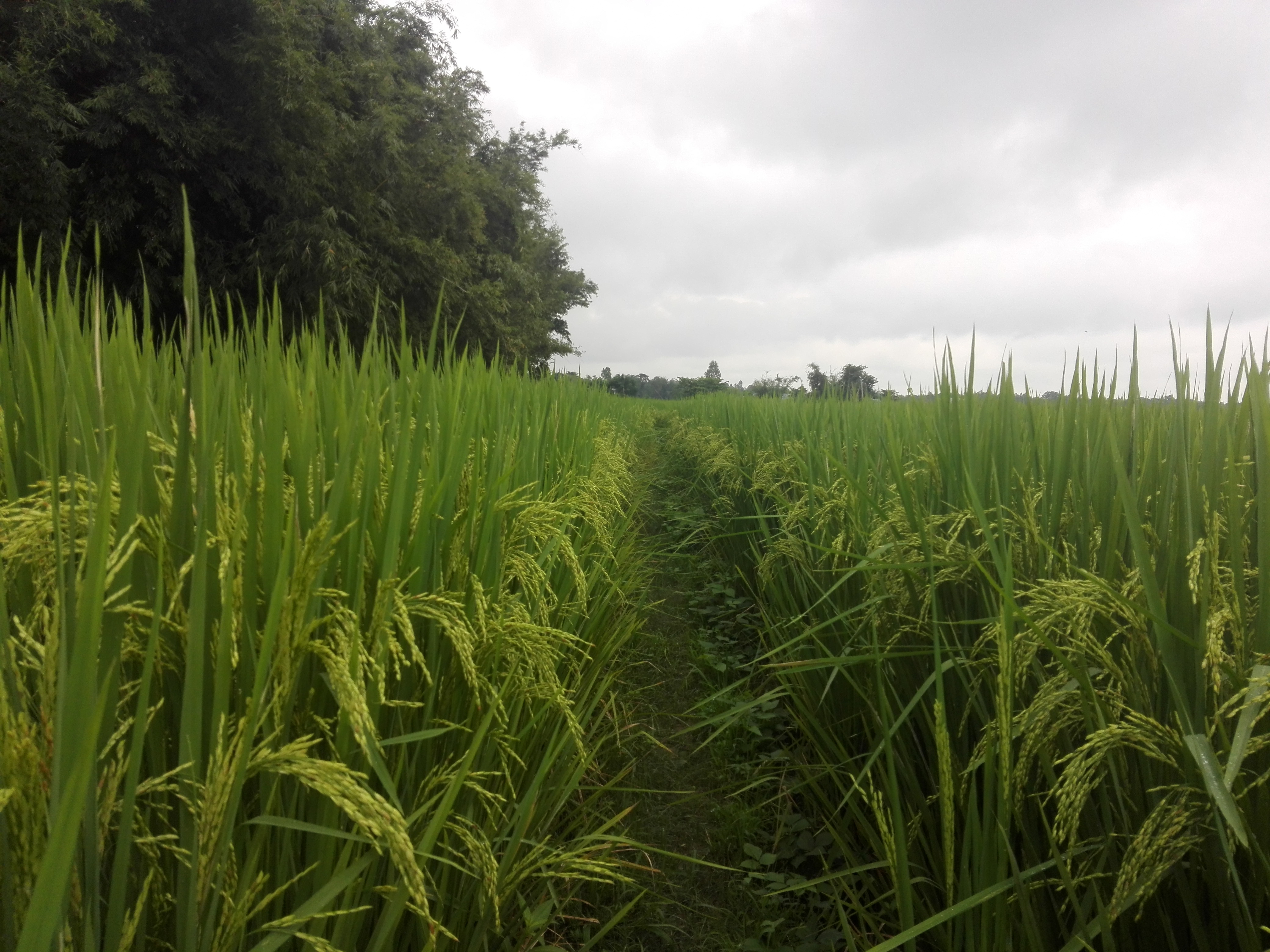
Showing posts with label glyphosphate. Show all posts

Thursday, November 21, 2019

Stifled

The Guardian (Oct. 26) has an extensive article on the recently published Golden Rice: The Imperiled Birth of a GMO Superfood by Ed Regis:
'Stifling international regulations have been blamed for delaying the approval of a food that could have helped save millions of lives this century. The claim is made in a new investigation of the controversy surrounding the development of Golden Rice by a team of international scientists.
Golden Rice is a form of normal white rice that has been genetically modified to provide vitamin A to counter blindness and other diseases in children in the developing world. It was developed two decades ago but is still struggling to gain approval in most nations.
“Golden Rice has not been made available to those for whom it was intended in the 20 years since it was created,” states the science writer Ed Regis. “Had it been allowed to grow in these nations, millions of lives would not have been lost to malnutrition, and millions of children would not have gone blind.”
...
“The effects of withholding, delaying or retarding Golden Rice development through overcautious regulation has imposed unconscionable costs in terms of years of sight and lives lost,” Regis concludes.
It looks like a great article in PR and up til now, the publication has received very little critique. It is also totally uncharacteristic of what Guardian normally publishes. Is their more balance?
Especially the claim that millions of lives have not been saved seems to be an exaggeration. Blaming others for the delay seems to bypass the central question. Why is big business so interested in pushing this (as the blame is placed with governments and NGO's)? Not self interest?

In Foreign Policy (Oct. 17), author Ed Regis discusses his own publication and emphasizes:
'This was Golden Rice, the fruit of nine years of research, experimentation, and development. The “gold” was in fact beta carotene, a substance that is converted into vitamin A in the human body. Conventional rice plants already contained beta carotene, but only in their leaves and stems, not in the kernels. Golden Rice also carries the substance in the part of the plant that people eat. This small change made Golden Rice into a miracle of nutrition: The rice could combat vitamin A deficiency in areas of the world where the condition is endemic and could, thereby, “save a million kids a year.”
A review (Oct. 3) from eea - John Hopkins University (the publisher):
'It is also true that Greenpeace had criticized and denounced Golden Rice, mocked and ridiculed it as an unrealistic, impractical, and even a dangerous foodstuff. Over the years since the prototype version was announced, Greenpeace had issued a practically endless stream of press releases, position papers, and miscellaneous other statements about Golden Rice that were filled with factual inaccuracies, distortions, and wild exaggerations of the truth. I learned, however, that none of these diatribes had done anything to stop, slow down, or interfere with the process of Golden Rice research and development, which proceeded at its own steady, albeit deliberate, pace.
Nor was Greenpeace guilty of mass murder or “crimes against humanity.” For even if their accusations against Golden Rice had the effect of retarding its development (which in fact they hadn’t), those accusations were not intended to cause harm, much less death, whereas murder is above all an intentional act'. 
This blog has highlighted much of the what was wrong with Golden Rice:
August 2018 citing GRAIN:
'Aside from its low content, the beta-carotene in Golden Rice also shows degradation. A study in 2017 shows that Golden Rice retains 60% of its original beta-carotene levels after 3 weeks of storage and just 13% after 10 weeks. A researcher notes that after 75 days, one has to eat as much as 32 kgs of cooked Golden Rice just to get the same amount of beta-carotene in a single carrot'.
December 2018 citing GRAIN:
'While these pro-GR groups keep tagging the Golden Rice detractors as ‘vandals’, they also continue to take for granted the realities of hunger that these farmers and the Asian peoples are experiencing on a daily basis. Our countries are blessed with bountiful resources to feed our population, but poverty and social inequalities stop people from procuring safe and nutritious food. Golden Rice will never solve VAD [vitamin A deficiency] and will only strengthen the status quo, benefiting only those interested in controlling our nations’ agricultural sector.
The real crime against humanity is committed by the pro-Golden Rice camp by peddling a GM product that is not tested nor proven to be safe. In fact, this can turn into a situation where the ‘medicine’ is worse than the illness it intends to cure.
Golden Rice is a techno-fix to malnutrition and a corporate ploy to control our agriculture. It is not needed by Asian people nor the world. Indeed, the solution to hunger and malnutrition lies in comprehensive approaches that ensure people have access to diverse sources of nutrition. Securing small farmers’ control over resources such as seed, appropriate technologies, water and land is the real key to improving food production and eradicating hunger and malnutrition'.
May 2017 citing GRAIN:
'A recent study made by scientist in India showed that the derived lines of Golden Rice produced phenotypic abnormality and poor agronomic performance making it unfit for commercial cultivation'.
December 2016:
'Looking at how Nobel prize winners were drawn into declaring their support for genetically modified organisms the oneworld (Nov. 7) article's author comes to some revealing disclosures. 

Though this saga has been highlighted earlier on this site, let's start with part of the article's intro:
'In June this year it hit the newspaper headlines. More than a hundred Nobel laureates call upon Greenpeace to immediately cease their resistance to genetic modification (GM). In specific the environmental organization was blasted for it's campaign against so-called “Golden Rice”, a genetically engineered rice variety 
...
Regulatory barriers for GM-technology should therefore be eased, the letter urges, and calls on “governments of the world“ to make this happen'.
The article reveals 
  • That Greenpeace does not "frustrate" the work of IRRI on Golden Rice,
  • that Greenpeace were not allowed to defend themselves at a press conference in Washington D.C., being refused entry by a representative of a PR firm who was formerly head of Monsanto's corporate communication,
  • the same person also provided public affairs guidance to the Nobel winners,
  • the same representative is a fixer between industry and scientists which seek to discredit organic food industry,
  • with this in mind there is apparently a target list of well-known / influential GMO doubters,
  • that the leader of Nobel Laureates efforts in this cause has a private stake in allowing wider acceptance of GMO's'. 
And we could look further back: November 2014 , May 2014, January 2014 and  October 2013. Just a few postings on the subject. 
More info from Stop Golden Rice Network. 
So there's enough to suggest a more balanced view is required.

Kind
Let's look more at the kingdom's rice issues.
Phnom Penh Post (Oct. 30) takes a look ahead:
'The Cambodia Rice Federation (CRF) has committed to raising the Kingdom’s rice exports to one million tonnes by 2022, its president Song Saran said on Wednesday. 
The comment was made at the Strategic Plan 2020-2023 Consultation Workshop, which was attended by CRF members, ministry representatives, government agencies and international stakeholders.In an effort to attain its goal, the CRF will export 35 per cent of its rice to the Chinese market, 30 per cent each to Europe and Asean countries, and five per cent to other markets said, Saran. 
Of that, luxury fragrant rice will account for 30 per cent of its exports, regular fragrant rice 40 per cent and regular rice 30 per cent, he said'.
Phnom Penh Post (Nov. 5) currently:
'The price of premier jasmine paddy is showing signs of stability as post-monsoon harvest season begins, insiders have said.
The harvest season of Phka Romduol – a variety of Cambodian premium rice – began about a week ago in some provinces such as Pursat, Prey Veng, Svay Rieng and Battambang, and will end late next month or in early January.
Cambodia Rice Federation (CRF) vice-president Chan Sokheang on Tuesday said the price of Phka Romduol is currently between 1,100 and 1,200 riel ($0.27 and $0.30) per kilogramme – a slight increase from last year.To promote rice exports, the CRF has urged all its members to stock up on Phka Romduol paddy, he said, adding that “this kind of paddy is in high demand on the international market”. 
Milled Phka Romduol rice sold on the international market may fetch $880-$900 per tonne, Sokheang said'.
Other marketing aspects. The Phnom Penh Post (Oct. 31):
'Cambodia is campaigning to boost its luxury fragrant rice exports to China, the world’s largest market, said Cambodia Rice Federation (CRF) vice-president Chan Sokheang on Thursday. 
Sokheang told The Post on Thursday that the CRF plans to achieve the quota that China provided Cambodia – 400,000 tonnes of rice per annum. 
The CRF has committed to exporting one million tonnes of rice globally by 2022, with 35 per cent to the Chinese market, of which 30 per cent is luxury fragrant rice, 40 per cent regular fragrant rice and 30 per cent regular rice. 
Sokheang said the federation’s campaign aims to boost fragrant rice exports to China and make up for a decline in exports to Europe'.
Khmer Times (Nov. 15) has more on China: 
'China imported 40 percent more rice from Cambodia from January to October this year over the same period last year, according to government data'.
Award
Across the eastern border, Vietnam is celebrating. Vientnamnews (Nov. 13):
'Việt Nam’s organic rice from Sóc Trăng ST24 was crowned the best in the world at The Rice Trader (TRT) World Rice Conference 2019 in Manila, the Philippines, on Tuesday. 
This is the first time Vietnamese rice has been awarded this title'.
Cambodia has won this a couple of times in the past, it exemplifies how also the Vietnamese are seeking to up their product.
Much to chagrin of Thailand. Bangkok Post (Nov. 18):
'Rice traders are calling on the Ministry of Agriculture and Agricultural Cooperatives to prioritise the development and improvement of rice varieties after Thailand's signature jasmine rice, Thai Hom Mali, failed to win the World's Best Rice award for a second year.
Vietnam's ST24 rice won this year's award, while Cambodia's premium fragrant rice, Malys Angkor, won the honours in 2018.
Chookiat Ophaswongse, honorary president of Thai Rice Exporters Association, said missing the award twice in a row indicates that their rivals have been continuously working on developing their product'.
Of course for every upside there's a downside. This from Thailand's the Nation (Nov. 5):
'Thai rice is in trouble, with the price of 5 per cent Broken White Rice and sticky rice being very low, Thai Rice Mills Association president Kriangsak Tapananon said. New jasmine rice in the beginning of the season will be earmarked for export, and the old rice will be consumed in Thailand, he added.
...
“In the highly competitive global market, our competitors have chosen to offer lower prices to attract buyers,” he said.
“To tackle this, we need to maybe recheck the whole rice export system,” Kriangsak said. “However, to do this by looking back at the market tendency, quantity, and price direction, the main problem is inevitably the production cost”.
Kriangsak said that to deal with the current market situation, the quantity of rice per rai should be increased to meet market demand, while new markets should be found for all kinds of rice.
It is also questionable whether the government’s policy of providing support only to the production sector including rice farmers is sufficient enough to help the entire rice trading system'.
The Nation (Oct. 23) looks at the overall market prospects for Thai produce:
'Rice exports are expected to reach between 8 million and 8.1 million tonnes this year, falling short of the target of 9 million tonnes, Thai Rice Exporters Association honorary president Chookiat Ophaswongse said this week.
That would make rice exports in 2019 lower than last year by 3.5 million tonnes.
Rice exports during the first nine months totalled 5.9 million tonnes, a reflection of the fierce competition from other countries'.
And then there's this. Nation (Nov. 5):
'Agriculture and Cooperatives Minister Chalermchai Sreeon has ordered the Department of Agriculture, the Rice Department and the Department of Agriculture Extension to look for a way to control an outbreak of rice blast disease scourging northeastern provinces.
The article mentions acreages of more than 50,000 ha affected'.
The Nation (Oct. 31) looks at market prospects in the Philippines for Thai rice:
'Keerati Rushchano, an inspector-general at the Commerce Ministry and acting director-general of its Department of Foreign Trade, said this week the Philippines had suspended implementation of an import protection measure that would have adversely affected Thai rice.
...
Thailand exported 543,344 tonnes to the Philippines in the first nine months of 2019, down 297,812 tonnes or 61.65 per cent year-on-year'.
Coconuts (Nov. 12) looks with more detail at the Filipino market for rice (imports?):
'The Philippines is the world’s number one importer of rice, surpassing even China, according to a new report released by the United States’ Department of Agriculture. The USDA-Foreign Agricultural Services (USDA-FAS) report, released on Nov. 8, shows that 3.1 million metric tons of rice were imported by the Philippines this year, compared to China’s 2.5 million metric tons. 
... 
In March this year, the government implemented the Rice Tarrification Law, or Republic Act 11203. The law removed import restrictions, leading to a greater amount of rice bought from overseas flooding the market. This move, according to experts, prompted local rice prices to plunge to PHP38 (US$0.75) per kilogram as of the end of September, 17 percent lower than last year’s price of PHP46 (US$0.90) per kilogram. However, prices failed to hit the government’s promised low of PHP27 (US$0.5o). 
The Philippines is also a major grower of rice, producing some 20 million tons a year, raising questions as to the impact of imports on prices for local growers. 
... 
As of October, the country’s national rice inventory was at 2.28 million metric tons, with some 1.9 million metric tons coming from imports, according to the Bureau of Customs. The share of imports is 43.4 percent higher than the previous year’s record of 1.59 million metric tons, according to the Philippine Daily Inquirer'.
Vientiane Times (Nov. 14) has a look at the people's prospects for rice production:
'The Ministry of Agriculture and Forestry yesterday defended its decision to lower the rice production target for 2019, saying it was unavoidable because of the severe flooding that had occurred this year and last.
At the same time, water shortages are currently affecting the north of Laos'.
Pha Khao Lao (Nov. 11) adds:
'Vientiane is continuing to expand irrigation systems with the goal of planting rice on an additional 555 hectares this dry season'.
Bust
Let's look at other crops.
Phnom Penh Post (Nov. 3) cites research that reflects positively on cassave vis-a-vis rice:
'The government and the United Nations Development Programme (UNDP) have called on farmers to grow cassava as a national policy on cassava production nears finalisation.
A UNDP study on Friday found that investing in cassava can result in higher yields than investing in rice, rice production, livestock, food and beverages, and tourism sectors. Direct revenue growth from the cassava sector is estimated to be about $130 million over 10 years.Speaking at the launch of the report, UNDP project manager Leang Reathmana said there is a growing demand for cassava from world markets – especially China – and the government and the private sector need to invest more in cassava'.
Rubber seems less positive. The Phnom Penh Post (Nov. 17):
'Rubber growers and exporters have expressed concern that prices will continue to fall as Thailand seeks to boost its natural rubber exports, industry insider Men Sopheak said.
In March, the International Tripartite Rubber Council (ITRC), which comprises Thailand, Indonesia and Malaysia, agreed to reduce rubber exports by about 240,000 tonnes from late in May to late September to buoy local prices, Reuters reported last week.
The three Southeast Asian neighbours, which produce 70 per cent of the world’s natural rubber, ended up slashing exports by 441,648 tonnes during the period.
Thai Minister of Commerce Jurin Laksanawisit told a conference of reporters and rubber growers on Wednesday that Thailand will boost natural rubber exports to increase incomes for the latter following implementation of the four-month curb agreement, Reuters reported'.
Khmer Times (Oct. 28) on cashew:
'Top Planning Japan Co., Ltd last week announced its intention to build a plant in Cambodia to process cashew nuts'.
On a side note there's this. New Mandala (Nov. 1) has an extensive article on Southeast Asia's love of boom to bust cycles in it's agricultural development:
'The transformative capacity of crop booms across Southeast Asia is alarming. Tree-based boom crops alone (e.g. rubber, oil palm, eucalyptus) are estimated to constitute 18% of the landscape in mainland Southeast Asia, a majority of which replaced forest land (Hurni and Fox 2018). The images presented above attest to the monumental landscape changes brought about by crop booms. What follows are extensive environmental problems including deforestation, land degradation, loss of biodiversity, as well as pollution and health risks from agri-chemicals and plastics. In northern Laos and Myanmar, for example, plastics used to protect young watermelon seedlings are burned after harvest, while plastic bags that insulate young banana branches in the winter months are later ploughed into the soil. In both cases, there is no attention to the long-term environmental consequences.
Boom crops also bring irrevocable economic and social changes. The cassava boom in Cambodia, for example, has brought new levels of cash income to some participating households, but contributes to the rising cost of land, food and other consumables. In boom regions, some households gain the capacity to build new houses, send children to school, or invest in agricultural and transport equipment, while others lose out and may enter vicious cycles of household debt and land loss. Thus, smallholder crop booms often exacerbate existing inequalities or create new economic differentiations.
...
... states and development aid organisations often approach booms with optimism, viewing them as potential engines for locally driven development and economic growth. When ‘booms go bust’ due to ecological collapse or market failure, those involved often look for the next crop boom opportunity instead of engaging in long-term planning of more sustainable modes of agricultural production. This level of complexity and the lack of visible, responsible actors makes it difficult to research as well as address the socio-environmental impacts of crop booms'.
Phnom Penh Post (Oct. 29) has additional info on business enabling:
'The Ministry of Commerce has intensified its decentralisation policy and shifted its responsibility for issuing certificates of origin (COs) to provincial commerce departments, it said on Monday.
To promote the Kingdom’s agricultural exports, the ministry announced a pilot launch from November 1 in three border provinces – Takeo, Kampot and Koh Kong. 
In 2017, the ministry authorised the Battambang and Pailin provincial departments of Commerce to issue COs to exporters.
... 
Hun Lak, a director at Longmate Agriculture Co Ltd which is a yellow banana planter and exporter, said provincial CO issuance will facilitate his exports.He said his company exported nearly 120,000 tonnes of yellow bananas to China, Vietnam and Japan in the first nine months of this year.
Longmate Agriculture has invested $32 million in yellow banana cultivation on more than 1,000ha in Kampot’s northwestern Chhouk district. The company is currently implementing the first phase of the project on 400ha'.
Further afield. Vietnamnews (Oct. 30) on coffee:
'As coffee exports dropped in both volume and turnover in the first nine months of this year, the Ministry of Industry and Trade said improving product quality and brand development are key for coffee export growth. 
Coffee exports reached 1.26 million tonnes, valued at US$2.17 billion, down 12.5 per cent ​​in volume and 20.9 per cent in value compared to the same period last year. 
To get Vietnamese coffee into foreign distribution systems, the Ministry of Industry and Trade said it would implement the scheme to help Vietnamese enterprises participate in overseas distribution networks by 2020, aiming to bring Vietnamese coffee directly into foreign markets'.
Thailand's Nation (Nov. 4) on pineapples:
'The Agricultural Research and Development Centre in Phetchaburi province has successfully created a new pineapple breed named “Petchaburi’s Pineapple 2” after 34 years of improvement by evaluating, selecting, comparing, and testing various breeds of pineapple, Department of Agriculture deputy director-general Surmsuk Salakpetch said'.
Suspect
Then let's finish with where we started. Controversy. 
In previous posts I've touched on the subject of the status of paraquat and glyphosate use in the region. As stated, Thailand is in the throes of deciding where to head to.
The Nation (Oct. 19) notes how farmers representatives are raising the stacks of the issue:
'Millions of sugarcane farmers and some academics have voiced opposition to the ban on farm chemicals paraquat and glyphosate, saying the discontinuation of these substances can cost the sugar industry as much as Bt570 billion.
...
The National Hazardous Substances Committee is scheduled to meet on October 27 to decide on whether the use of three toxic farming chemicals -- paraquat, glyphosate and chlorpyrifos – should be banned.
The panel set up by the government had proposed to end the use of the three chemicals from December 1, as they are considered to be harmful to people’s health and cause soil contamination'.
But it doesn't seem to help. Nation (Oct. 22):
'Twenty-six members of the Hazardous Substance Committee have reached a verdict to approve a planned ban on three toxic pesticides – Paraquat, Chlorpyrifos and Glyphosate – which are widely used in agriculture, Deputy Prime Minister and Public Health Minister Anutin Charnvirakul posted on his personal Facebook page on Tuesday'.
The discussion also reached Cambodia. The Phnom Penh Post (Oct. 24):
'Thailand edged closer on Tuesday to banning glyphosate and two other controversial pesticides despite protests from farmers in a multibillion-dollar agriculture industry aiming to be the “kitchen of the world”.
The agriculture sector employs 40 per cent of Thailand’s population, and the Southeast Asian country is one of the world’s leading rice and sugar exporters.It is also one of the biggest consumers of pesticides that are currently being banned or phased out in other parts of the globe because of links to a variety of illnesses.Thailand’s National Hazardous Substances Committee voted to ban glyphosate and chemicals paraquat and chlorpyrifos, officials said.
 ...
Vietnam banned all herbicides containing glyphosate soon after the Roundup cases in the US, but the decision was swiftly denounced by the US Secretary of Agriculture, who said it would impact global agricultural production. 
Thailand’s health minister, who has argued that the pesticides put lives at risk, praised Tuesday’s move as “heroic” on his Facebook page, as several dozen farmers protested, citing a rise in production costs. 
“If we don’t have the chemicals to eradicate the weeds, we will have to use more labourers,” said Charat Narunchron of a farmers association in Chanthaburi province, who called the ban “unfair”.Thailand’s Pesticide Alert Network – which has long advocated for the ban – thanked the government, but said it needs to help farmers adjust to other methods'.
The Bangkok Post (Oct. 26) highlights that prices of the to be banned chemicals are going down. 

Even the US is weighing in, not objectively. The Nation (Oct. 25):
'The US has urged Thailand to take scientific evidence into account and weigh the consequences of a ban on the use of glyphosate, a weed-control chemical.
Replying to questions from The Nation on Thailand’s plan to ban three farm chemicals -- paraquat, chlorpyrifos and glyphosate -- US Embassy spokesperson Jillian Bonnardeaux said: “We are aware that letters from the US Department of Agriculture to Royal Thai Government officials are currently circulating in the media in Thailand,” clarifying about news reports that the US government had sent letters to the Thai government urging a review of the ban on glyphosate used to control weeds.
“The United States would expect Thailand, as it would all of our trading partners, to base regulatory measures on scientific evidence and take into account international standards. Should the ban be implemented in Thailand, it will severely impact Thailand’s imports of agricultural commodities such as soybeans and wheat. The ban would negatively impact both Thai farmers and trading partners,” she noted'.
Note, Bangkok Post (Oct. 26):
'Prime Minister Prayut Chan-o-cha on Friday said officials would be assigned to clearly explain Thailand’s position to the US embassy about an official document submitted to the Thai government objecting to the country’s policy of banning three toxic farm chemicals'.
Bangkok Post (Oct. 27):
'US President Donald Trump's decision to suspend $1.3 billion (39.2 billion baht) in trade preferences for Thailand under the Generalised System of Preferences (GSP) has raised suspicion it is in retaliation for Thailand's ban on the use of herbicide glyphosate'.
And more pressure. Nation (Oct. 26):
'A farmers’ body will appeal to the Central Administrative Court on Monday (October 28) to issue an injunction on the ban of toxic agricultural chemicals – paraquat, chlorpyrifos and glyphosate – which was approved by the unanimous vote of Hazardous Substance Committee on Tuesday.
Sukan Sangwanna, secretary-general of Federation of Safe Agriculture (FSA), said on Saturday that the FSA and representatives of farmers who grow six economic crops including sugarcane, tapioca, oil palm, rubber, corn, and fruits will approach the court seeking a stay.
...
Sukan added that he will submit a letter to Hazardous Substance Committee to question the possible double standard practice of Thailand still importing fruits and vegetables from countries that allow paraquat and glyphosate, including China, Japan and the US. “If we ban these substances in Thailand, we should stop importing products from these countries too, or else domestic products won’t be able to compete due to increased costs.”
Statistics from Department of Agriculture reveal that currently Thailand still has stocks of these three chemicals of nearly 30,000 tonnes, whereas the cost to safely eliminate them is estimated at Bt3 billion'.
But ... The Nation (Oct. 31):
'Agriculture and Cooperatives Minister Chalermchai Sri-on has ordered the ministry’s permanent secretary and subsidiary agencies to speed their search for biochemical and microbial pesticides as substitutes for the newly banned toxic chemicals paraquat, chlorpyrifos and glyphosate'.
Rice farmers are unaffected? Bangkok Post (Nov. 9):
'Rice exporters have thrown their full support behind the ban on three toxic farm chemicals, saying importer countries have tightened their order of crops based on food safety.
Charoen Laothamatas, president of the Thai Rice Exporters Association, said the group agrees with the government's decision to ban paraquat, glyphosate and chlorpyrifos, and has asked farmers to adjust by reducing the use of chemicals.
"Many rice buyers have tightened their measures to protect consumers," Mr Charoen said. "If Thai farmers ignore the ban or do not reduce chemical use, rice exports will be affected."
He said global rice consumption is shifting towards chemical-free products'.
And now the tears. Nation (Nov. 13):
'Dr Kitti Chunhawong, president of Thailand Society of Sugarcane Technologists (TSSCT) insisted on Tuesday (November 12) that the banning of 3 agrochemical substances namely Paraquat, Chlorpyrifos and Glyphosate by the Hazardous Substance Committee, which came into effect last month, will severely affect the sugar industry'.
To be continued ...

Friday, October 18, 2019

In line


Starting off with news on Thai struggles with noxious agro-chemicals. 
The Bangkok Post (Oct. 3) to the kick-off:
'Rifts within the Agriculture and Cooperatives Ministry over a proposed ban on three toxic farm herbicides are deepening amid claims the minister urged his staff to restrict the use of paraquat, glyphosate and chlorpyrifos, instead of banning them completely'.
So no ban, but restrictions. The pressure on the Ag Ministry though continues. The Bangkok Post (Oct. 7):
'Representatives of the government, farmers and consumers have unanimously voted to ban the use of three toxic farming chemicals in December in a decision that could end the months-long controversial issue.
Deputy Agriculture and Agricultural Cooperatives Minister Mananya Thaiset said on Monday the working group comprising the three groups voted 9-0 in favour of the ban on three chemicals — paraquat, glyphosate and chlorpyrifos — starting Dec 1 at a meeting at the ministry.
From that date, it will be illegal to have, sell, import or produce the substances'.
Bangkok Post (Oct. 12) notes more pressure:
'Ministers attached to the Bhumjaithai Party will quit their jobs if they fail to convince the authorities to ban three pesticides that have been used for farming despite their high toxicity, party leader and Deputy Prime Minister Anutin Charnvirakul said on Saturday.
Mr Anutin, who is also Public Health Minister, said that he and his colleague, Deputy Agriculture Minister Mananya Thaiset, are ready to show their spirit by tendering their resignations if the proposed ban is shot down by the National Hazardous Substances Committee (NHSC).
“We need to go because the failure means we have no power to rule,” Mr Anutin said.
Mr Anutin and Ms Mananya have spearheaded the campaign to ban the use of paraquat, glyphosate and chlorpyrifos, which are harmful to the environment and health'.
Meanwhile over in Laos, concern on pesticides has also been voiced, though the approach seems different.  The Vientiane Times (Oct. 17):
'The Ministry of Agriculture and Forestry has issued a new regulation that enables authorities to check the quality and safety of pesticides before they are used on crops in Laos.
...
The minister’s decision to issue the pesticide regulation came amid growing concerns over the safety level of pesticides, which are imported for use in agriculture. 
In the middle of this year, the government came under strong pressure, especially from the National Assembly, which demanded that the government stop the import of dangerous pesticides and chemicals and ensured that such products were of good quality before being used by crop growers in Laos.
In response to pressure from law makers and the public, the government announced it was suspending the cultivation of some cash crops after learning that the pesticides used in these areas had a harmful effect on farmers and local residents.
Observers believe that this regulation, which requires the producers and importers of pesticides to register their products, will enable the authorities to carry out checks on the quality and safety of pesticides used in Laos. The move is in line with the government’s policy to promote clean and sustainable agricultural practices'.
So despite all indications that a ban is required, the Lao authorities also prefer restrictions.
 
Lost
Cambodia's rice news revolves around statistics. 
For instance recapping the rice trade figures (Phnom Penh Post, Sep. 25):
'Cambodian rice exports to international markets were worth more than $265 million in the first eight months of the year, said Cambodia Rice Federation (CRF) secretary-general Lun Yeng.
Yeng told The Post on Wednesday that the Kingdom exported more than 340,000 tonnes of rice during the period. Rice exports last year, he said, reached more than 620,000 tonnes or more than $473 million'.
The outlook as always seems bright. The Phnom Penh Post (Oct. 14):
'After three consecutive quarters of decline, Cambodia’s rice exports to the European market are expected to grow in the fourth quarter following a Cambodia Rice Federation (CRF) working group’s visit to the EU to promote the produce, CRF president Song Saran said.
The exports dropped sharply in the first nine months after the EU imposed tariffs on the Kingdom’s rice at the beginning of this year.
Saran led the working group to several European countries to meet with various parties and look into issues related to Cambodian rice.
Following the EU’s import duty on Cambodian rice, price competition with other countries led to a decline in exports to Europe, he said.
...
A CRF report shows that the Kingdom’s rice exports reached 398,586 tonnes in the first nine months of this year – up 2.3 per cent from the same period last year, or 389,264 tonnes.
Rice shipments to the Chinese market stood at 157,793 tonnes during the period. This was up more than 44 per cent year-on-year. But exports to Europe fell to 135,471 tonnes, or down nearly 30 per cent.
The rest was exported to Asean markets, said the report'.
However despite the upbeat, the market in Europe for Cambodia rice imports (and Cambodian imports in general) is (as known) clouded by the Everything-but-arms-trade concessions that were revoked.  The Bangkok Post (Sep. 30):
'A World Bank report estimates [for Cambodia] lost export revenue of $654 million -- $510 million for garments and footwear and $144 million for milled rice -- if the European Commission (EC) ends the EBA privileges, which have been in place for 18 years.
...
Meanwhile rice traders are trying to direct the local market. The Phnom Penh Post (Sep 25):
'The Cambodia Rice Federation (CRF) has called on farmers to delay their paddy sales until after the Pchum Ben festival to avoid a drop in prices.
CRF secretary-general Lun Yeng said on Wednesday that more than 80 per cent of rice millers had postponed purchases of paddy since earlier this week, which has allowed brokers to buy it at prices lower than the market rate.
“If their paddy is not [at risk of being] affected by floods or destroyed by insects, farmers should not rush to harvest. Good paddy should not be priced below 1,150-1,200 riel [$0.28-$0.29] per kilogramme,” he said.
Narum, a rice farmer in Kratie province, said prices in the province were not as high as they were last year. This time last year, he could sell paddy for between 900 and 1,000 riel per kilogramme, but must now settle for between 700 and 800 riel'.
Polished
Over in Thailand, the Bangkok Post (Sep. 15) reports on the Thai rice price pay-off system:
'The rice price guarantee scheme will begin next month with farmers set to be paid the difference when the price falls below a predetermined benchmark, Deputy Prime Minister and Commerce Minister Jurin Laksanawisit said'.
And then in more detail. Bangkok Post (Oct. 16):
'The rice price guarantee scheme started on Tuesday, with eligible farmers set to receive the difference when market prices fall below the predetermined benchmark.
Commerce Minister Jurin Laksanawisit said the state-owned Bank for Agriculture and Agricultural Cooperatives (BAAC) transferred 9.4 billion baht in compensation directly to the accounts of 349,000 registered farmers.
The compensation will be paid mainly to growers of white rice paddy and fragrant Pathum Thani rice paddy if the market prices stay below a certain level.
Mr Jurin said the government is scheduled to pay the compensation every 15 days until the end of the harvest season'.
Vietnam has also been doing the numbers.  Vietnamnet (Oct. 8):
'According to Tran Thanh Hai, deputy director of the Import/Export Department under the Ministry of Industry and Trade (MOIT), Vietnam exported 5.4 million tons of rice in the first eight months of the year, an increase of 0.1 percent over the same period last year, but the export value was $1.96 billion, a decrease of 15 percent.
...
China, which was the biggest rice importer of Vietnam in previous years, has cut purchases. Exports to the market dropped by 65 percent.
In 2018, Vietnam sold rice at $500 per ton on average, but the price decreased in 2019. China, which imported rice in large quantities across border gates in previous years, began restricting imports through this channel in 2018.
Moreover, China has also begun applying the rice import quota scheme. It plans to import 5 million tons of rice this year, but in fact, it has imported 3.3 million only'.
Rice news from Laos.  Vientiane Times (16 Sep.):
'Many agricultural promotion companies in Laos have limited their rice exports because of the supply shortage in the domestic market despite high demand from overseas.
High rice prices and the impact of flooding within the country this season are the main reasons why farmers are storing rice for their own consumption, according to the industry and commerce sector.
Laos recently exported only 1,350 tonnes of polished rice to China as part of a 50,000-tonne export quota agreement between the Lao government and China National Cereals, Oils and Foodstuffs Corporation (COFCO)'.
So there's a shortage in the local market as there's also a need to export to China. Then the Vientiane Times (Sep. 27) reports on government measures to cool the market:
'The government has approved the sale of 2,000 tonnes of stockpiled rice to bring down the high market price after a shortage of supply meant the price of rice rose by over 20 percent above normal.
The move is aimed at cutting costs for consumers and easing the hardship of people on low and medium level incomes.
The Vientiane Industry and Commerce Department has directed the Khamphaengphet Chaengsavang Agriculture Promotion Co., Ltd. to sell the 2,000 tonnes of rice after the government and the company signed a contract to that effect.
Polished Grade B sticky rice is on sale at five locations in Vientiane for 6,500 kip per kg, from September 23-30. This price is 2,000 kip per kg less than the current market price. 
...
The government regularly stockpiles rice and has supplies available every year which can be put on sale when the market price of the staple becomes unacceptably high. This year, the price of polished sticky rice rose to an abnormally high level after a prolonged dry season followed by widespread flooding, meaning that rice yields were below the set target.
From January to June, the price of rice in Vientiane, mainly paddy sticky rice, rose by 3,425-3,500 kip per kg and the price of polished Grade B sticky rice by 6,335-7,000 kip per kg, according to the Vientiane Industry and Commerce Department.
From the end of June to September, the price of rice increased further to about 4,350 kip per kg for paddy sticky rice in the second week of September. Compared to June this was an increase of 1,500 kip or 24.28 percent, the Director of the Vientiane Industry and Commerce Department Director, Mr Berlin Phetchantharath, told the media.
The release of stockpiled rice is authorised by the Decree on the Management of Goods Price and Services No. 474/PM, dated November 18, 2010. The decree followed the appointment of a steering committee on the management of goods price and services in Vientiane'.
Tightlip
As an intermezzo, a feature from Nepal's Kathmandu Post (Oct. 13) on hybrid rice:
'There is a reason why Thakur is upbeat. This year, he is expecting to produce 9 tonnes of paddy on a hectare of land — three times the national average paddy productivity rate.
All this is because Thakur cultivated two high yielding hybrid varieties— Arize 6444 Gold and Arize Idea hybrids. He owns 1.7 hectares (2.5 bigas) of land. As the ripening period of these varieties is 125 days, Thakur is expecting to harvest his crop towards the end of October. The early ripening time has also given him ample time to prepare for a mustard farm in the next cropping cycle.
...
Thakur is expecting to at least double his income this year. “People, mostly my neighbors, had called me crazy when I decided to go for a hybrid variety,” remembers Thakur. “They are all tightlipped now.”
In Nepal, most farmers do not use hybrid paddy because they cannot produce the seed and have to buy them every year from the market.
But Thakur decided to take the risk. His hybrid journey began after he got a handful of hybrid paddy seeds from Nepal Krishi Company, Buddha Air’s corporate social responsibility initiative that works on farm mechanisation and commercialisation.
Thakur is a bit worried as well. “Since it’s a new variety, I don’t know what rate I will get for my produce. I don’t know if consumers will prefer eating these varieties.”
...
Farmers in the area say that hybrid varieties have many advantages but there are disadvantages as well. “We have to buy the hybrid varieties every year from the market as it cannot be reproduced,” she Khanal. “We are worried that it may make us dependent on seeds. “It’s expensive as well.”
The price for Arize 6444 seeds per kilo is Rs600 while Ranjit costs Rs70 per kg.
...
Nepal Krishi Company and Bayer BioScience of India had signed a memorandum of understanding last May to begin a pilot project to use two-hybrid paddy seeds this summer which have the potential to double productivity.
The company has piloted these hybrid varieties on 35 bighas of land. Out of the total land, these varieties have been cultivated with the latest technology and tools on a demonstration plot of 20 bighas owned by Birendra Bahadur Basnet, managing director of Buddha Air, who is also a board member of Nepal Krishi Company. The remaining 15 bigas are owned by the local farmers.
“By October end, we will see the result—the actual cost of production and productivity—of the hybrid varieties,” Basnet says. “The Krishi company’s objective is not only to produce paddy but we want to establish the fact that paddy farming can be done commercially.”
As always, it's about economics. It's also strange that a company uses a social initiative to push hybrid rice with a multinational company which only has one interest.

Dispersed
The Khmer Times (Oct. 7) reports on investment on Cambodian agriculture:
'Green Leader Holding Group Limited, a Hong Kong-listed firm, announced last week that it is increasing investment in the local market by building a new mango processing plant in Tboung Khmum province.
...
In May, Green Leader opened a $20-million cassava-processing factory in Kratie’s Snuol district
The company said the facility can process up to 130,000 tonnes of starch a year, absorbing 500,000 tonnes of raw cassava'.
More mango news. Khmer Times (Oct. 4):
'Cambodian mangoes are ready for export to the South Korea market with the first shipment officially kicking off in early November, Hyundai Agro, the Korean exporter, said.
...
Although the company got permission from the government, Chang Hoon Lee noted that there is another obstacle when it comes to competition with Vietnam, Thailand, Peru, and the Philippines.
Vietnam and Thailand have an air cargo connection with South Korea and enjoy a very low cost of transportation. Every day, Thailand sends more than 100 tonnes of mangoes to Korea and they are dispersed everywhere in one day, while Vietnam’s duties for mango exports are lower than for Cambodia because of the free trade agreement area, Mr Lee pointed out.
...
He noted that there are no cargo airplanes between Korea and Cambodia so the company is figuring out how to send 10 to 15 tonnes of mango by ship'.
Khmer Times (Oct. 2) looks at the evolving trade issues concerning Kampot's pepper:
'A lack of demand is driving a large number of Kampot pepper farmers to quit the crop, the Kampot Pepper Promotion Association said yesterday.
Many farmers are finding it difficult to sell their harvests, according to KPPA president Ngoun Lay. He estimates that 20 to 25 percent of small-scale farmers (those farming less than 3,000 square meters of land) have abandoned the crop after this year’s harvest season, which recently finished.
Mr Lay said an oversupply of the crop is causing farmers in Kampot and Kep provinces to switch to other crops like mango.
...
“For example, before a buyer would order 10 to 20 tonnes of pepper, but now they only need from 2 to 10 tonnes because they are also growing the pepper themselves. This is hurting farmers,” he said.
He noted that the crop is now grown in 290 hectares of land in both provinces by 445 farmers. Combined, those farmers produce a total of 100 tonnes a year on average, but buyers are demanding only about 70 tonnes a year.
A kilogram of Kampot black pepper fetches $15, while red pepper and white pepper sell for $25 and $28 per kilogram, respectively. However, some farmers have had to sell their black pepper for $13 a kilogram, red pepper for $22 and white pepper for $26, Mr Lay noted.
...
Low-quality pepper used to fetch $10 per kilogram, but now, due to oversupply, some farmers are selling it to Vietnamese merchants for as low as $2 per kilogram'.
Rubber. The Phnom Penh Post (Oct. 14):
'Cambodia exported $231 million worth of rubber in the first nine months of this year, a year-on-year increase of nearly 22 per cent from $190 million last year, a Ministry of Agriculture, Forestry and Fisheries official said on Monday.
Khuon Phalla, director of the Department of Administration and Legislation under the ministry’s General Directorate of Rubber, told The Post on Monday that Cambodia’s rubber exports during the period reached 173,072 tonnes, a year-on-year increase of 23.35 per cent from 140,303 tonnes.
...
However, Sopheak Nika Investment Agro-Industrial Plants Co Ltd director Men Sopheak said the rubber market during this period was not as strong as last year.
The current rise in rubber exports is merely due to an increase in the number of mature rubber trees, he said, which produce a larger harvest from year to year'.
Some news on evolving land issues. Taking a French company to a higher level. The Phnom Penh Post (Oct. 1):
'The group, from seven villages in Pech Chreada district’s Bou Sra commune, filed a lawsuit at a French court last year to claim damages and demand compensation from Bollore, a firm that funded Socfin-KCD.
They said they were under threat of losing their land, traditions and customs since the arrival of Socfin-KCD, which had received loans from Bollore to operate a rubber plantation in Mondulkiri since 2008.
...
He said some 800 families, mostly Bunong indigenous members, have been severely affected by the project after Socfin-KCD obtained investment rights to plant rubber trees and other cash crops on 2,368ha on a 70-year contract.
Of the more than 800 families, he added, 640 are directly involved in the land dispute. They turned to the French court after the provincial authorities claimed the dispute had been solved'.
Control
Couple of snippets from the region. 
Oddly, the Phnom Penh Post (Oct. 1) reports on sugar concerns:
'The Thai sugar industry has been hit by the twin crises of falling exports and sliding prices, industry experts have said.
The most imminent threat to the industry is the falling price of sugar in the global market, which has currently dropped by $0.22-$0.24 per kilogramme, the lowest price in six years'.
Then the focus shifts towards Vietnam. The Phnom Penh Post (Oct. 10):
'Vietnam is in the process of getting a licence to export avocado to the US, according to the Vietnam Trade Office in the US.
The Vietnam Trade Office’s branch in the US’ San Francisco said avocados are mainly sold at big supermarkets with large volumes, so they must meet the high requirements of the US market.
Avocado distribution companies must be responsible for controlling the stages of a supply chain, from production to distribution, while exporters need to have sufficient quality certificates.
To enter the US market, avocados must meet the minimum requirements of the regulations on maturity, colour and weight. Avocados must be intact, clean and without insects.
...
In Vietnam, avocado trees are now grown in many provinces and cities, but concentrated in the Central Highlands region with a total area of 8,000ha.
Dak Lak province – which borders Mondulkiri province’s northern Koh Nhek district in Cambodia – is the largest producer in Vietnam with a total area of more than 4,300ha.
Following are Dak Nong province – across the border from Mondulkiri’s southeastern O’Raing district – with an area of nearly 2,600ha, Lam Dong province and Gia Lai province – which borders Cambodia’s Andong Meas and O’Yadav districts in Ratanakkiri province'.

Saturday, March 9, 2019

Bamboo

Starting totally different this time round with an interesting byte from Laos.
On a recent highly listen worthy eatthispodcast (Jan 21), there's an interview with longtime Lao agro expert Michael Victor:
'Most recently, he’s been working with The Agro-biodiversity Initiative, funded by the Swiss Agency for Development and Cooperation. The idea is to make use of agricultural biodiversity in a sustainable way to reduce poverty and improve the livelihoods of people in upland regions. One thing the project has done is to collect all the information it can about agricultural biodiversity and make it available online'.
With sticky rice as the country's main stay both from the view of production and consumption, Michael explains how conserving past knowledge of the agro-forest livelihoods can help new generations become aware of their traditional foods and food habits which can assist in playing a major role in the conservation of Laos' forest lands. 
The website of the project is Pha Khao Lao, well worth a visit.

Raw
Cambodia's rice news still revolves around the tariffs imposed by the EU. 
The Khmer Times (Feb. 13):
'Rice exports in January saw a small decline that exporters have blamed on the European Union’s decision last month to impose tariffs on local rice.
Last month, Cambodia exported 59,625 tonnes of rice to international markets, a 5 percent drop compared to January 2018, according to a report issued yesterday by the Secretariat of One Window Service for Rice Export Formality'.
Vietnam has come to the rescue. Phnom Penh Post (Feb. 15):
'After the EU decided to impose tariffs on Cambodia’s rice exports from January, Vietnam agreed this week to expand its import quota for the Kingdom’s rice to 300,000 tonnes.
Vietnam’s actions come as the Chinese government late last night agreed to increase its import quota for the Kingdom’s rice to 400,000 tonnes this year from the previous year’s 300,000 tonnes.
...
Amru Rice (Cambodia) Co Ltd chairman and CEO Song Saran on Thursday said Vietnam is generally buying raw products such as paddy, rather than milled, rice.
However, he said the quota would encourage more Vietnamese to import the Kingdom’s rice, despite needing time to reach the 300,000-tonne quota.
“We expected more demand to come from Vietnam in the incoming years. It will take time to convince Vietnamese consumers and traders to import rice."
“It is also possible that in the long term, more Vietnamese consumers will be interested in high-quality rice since the Vietnam middle classes have grown a lot in recent years.”
Having higher quotas from China and Vietnam is helpful to the marketing of Cambodian rice. But, Chinese and Vietnamese buyers in the past did not buy as much as they agreed to. The reason, according to industry insiders, is because buyers offer lower prices'.
Phnom Penh Post (Feb. 20) repeats the above but with more detail:
'The Kingdom’s rice exports saw little change during the last three years to 2018 as the sector appears to face new challenges requiring the government and private sector to work harder to keep the industry healthy.
The challenges are centred around the EU market as the bloc imposes tariffs on Cambodia’s rice, added on to existing issues such as higher production costs and a lack of infrastructure.
However, industry insiders said the volume of this year’s rice exports will remain steady due to a new quota from China and Vietnam.
Ministry of Agriculture, Forestry and Fisheries figures show that the Kingdom exported 626,225 tonnes of rice last year, decreasing 1.5 per cent from 635,679 tonnes in 2017.
The figures show that the main destinations were the EU with a total of 269,127 tonnes and China with 170,154 tonnes.
...
Centre for Policy Studies director Chan Sophal said that while the country has missed its target export of one million tonnes since 2015, its rice exports stand at around 600,000 tonnes. He said the higher production costs and the lack of the sector’s infrastructure are limiting competition.
“For this year’s exports, [I] predict that they may not increase because tax needs to be paid to export Cambodia’s fragrant rice to the EU market,” he said.
Sophal said that while the government is trying to boost the sector by cutting production costs to improve its competitiveness, it needs to improve infrastructure – roads and irrigation systems.
Faced with the EU’s decision to impose import tariffs, Cambodia’s rice could face a much more serious issue if the EU’s preferential Everything But Arms agreement is withdrawn.
Sophal said it is preferable if the Kingdom diversifies its export destinations, rather than rely on any one market'.
Even the Asianews Network (Feb. 21) highlights the kingdom's need to change direction:
'Prime Minister Hun Sen said the government will take more action to raise the Kingdom’s rice exports, including reducing production costs and boosting market competitiveness'.
Measures include:
'“We will set up a new policy to reduce production cost such as connecting electricity supply to regions with water access, by replacing diesel machines with electric ones,” he said.
Hun Sen also encouraged studying domestic fertiliser production to produce cheaper options for the rice industry and reduce production costs.
Relevant ministers, including those leading the Commerce and Agriculture, and Forestry and Fisheries departments, need to expand and seek new markets as Cambodia has world-famous, high-quality rice, he said'.
The Phnom Penh Post (Feb. 23) reports on more possible potential lifelines for the rice sector:
'Four days after the EU imposed tariffs on rice imported from Cambodia, China agreed on Monday to increase its import quota for Cambodian rice to 400,000 tonnes this year from the previous 300,000 tonnes.
If Cambodia can supply the quantity under the new Chinese quota, then that market alone would effectively absorb 63 per cent of Cambodian rice sold abroad based on last year’s export of 626,225 tonnes
...
The Chinese market is the largest for Cambodian rice in terms of individual countries, and it is the second-largest buyer after the European bloc. Last year, China bought 170,154 tonnes of rice from Cambodia or equal to 56 per cent of the latest quota.
Centre for Policy Studies director Chan Sophal said that having a higher quota from China will be helpful to the marketing of Cambodian rice, but in the past, Chinese buyers found rice in Vietnam and Thailand more competitively priced and did not buy as much as they agreed'.
Backnews. The Phnom Penh Post (Mar. 1) reports: 
'The state-owned Rural Development Bank (RDB) distributed $50 million in loans to private rice millers last year to sustain the paddy market for farmers, according to RDB CEO Kao Thach.Thach told The Post on Thursday that despite many provinces in the Kingdom facing drought, the demand for loans remains high'.
Sought
Beyond the Khmer border, rice related news; as usual mostly from Thailand. The Bangkok Post (Feb. 19) kicks off this section with a docile bit:
'The cabinet has approved a rice insurance scheme for the 2019 season worth 1.74 billion baht, aiming to cover 30 million rai of farmland.
...
Participating farmers will be charged an insurance premium of 59 baht per rai, with the government paying 35.40 baht per rai as a subsidy, and farmers paying 23.60 baht per rai'.
Bangkok Post (Mar. 8) curiously sees farmers looking east:
'Farmers in Nakhon Sawa insist they will continue growing Vietnamese fragrant rice, an unregistered variety they say is disease resistant, amid rumours the government is trying to dissuade them by forcing the price down.
Suthep Khongmak, chairman of the Thai Rice Growers Association, said on Friday that he had recently visited Nakhon Sawan and talked with farmers who were planting Vietnamese fragrant rice variety Jasmine 85, known locally as Hom Phuang rice.  
Rumours had it that the Rice Department had sent a letter seeking cooperation from rice mills to force the price down as the variety was not a native grain and not registered in the country, Mr Suthep said.  
...
Farmers said it was easily grown, disease resistant and in high market demand. Of course they preferred it'.
 Vientiane Times (Feb 21) puts it's hopes on China:
'The Lao Ministry of Industry and Commerce this week requested China to consider a rice im-port quota of 50,000 tonnes along with accepting other industrial goods as part of efforts to bol-ster bilateral trade.

...
The call for the increased rice quota comes after 20,000 tonnes were shipped to the northern neighbour in 2017 by China’s Xuanye (Lao) Co., Ltd following approval from China’s NDRC'.
None lesser than the Guardian (Jan. 30) hails SRI (System of Rice Intensification) techniques in the region:
'Jesuit priest Henri de Lalanié working in the highlands observed that by planting far fewer seeds than usual, using organic matter as a fertiliser and keeping the rice plants alternately wet and dry rather than flooded, resulted in yields that were increased by between 20 and 200%, while water use was halved. Giving plants more oxygen, minimising the competition between them and strictly controlling the water they receive is thought to make them stronger and more resilient to flood and drought.
...
Academic criticism has since all but disappeared and the SRI system of farming has been validated in hundreds of scientific papers and adopted by up to 20 million farmers in 61 countries, according to the SRI information centre in Cornell University.
“The results consistently cite yield increases, decreased use of seed, water and chemicals, and increased income,” says Norman Uphoff, professor of global agriculture at Cornell.
...
But what is now exciting some of the world’s largest food corporations and governments is that growing rice along SRI principles also greatly reduces emissions of the powerful greenhouse gas methane, which escapes when rice, or any other crop, lies waterlogged for weeks at a time.
....
[Sunny Verghese, CEO of Singapore-based Olam]:
“But reducing emissions from rice cannot be a trade-off that hurts farmers and communities who depend on it for their income and sustenance. We have to measure the true cost of food and dismantle the subsidy system.”
Working with German development agency GIZ and south-east Asian governments, Olam now plan to roll out SRP rice to 100,000 farmers in Thailand, Cambodia, Vietnam and India within five years, increasing yields and incomes, and reducing methane emissions by 50%'.
Fight
The Thai junta has been trying to push through new legislation in a bid to control rice production in Thailand. The press has not been ummm ... impressed. Bangkok Post opinion (Feb. 17): 
'The National Legislative Assembly (NLA) made the right decision in backing down on the Rice Bill fight, removing controversial content which drew hefty criticism. It agreed to take out a contentious section that prohibits the trade of rice seeds which are not approved under requirements set by the bill. This positive response is good but is not enough.
...
Despite its good intentions, the bill seems to be riddled with several shortcomings. To start with, it gives too much power to the government. The rice board, in accordance with Section 6, shows an imbalanced structure with state officials, at 20, outnumbering those from farmers and rice mill groups which are to have five members each while there are three seats for experts.
...
Critics are of the opinion that the mandatory registration of rice varieties, as mentioned in Section 27, will do more harm than good to the country's rice development.
...
"If this draft was issued and became effective before 1957, Thailand would have possibly missed high-value rice varieties such as Khao Dawk Mali 105 rice, Khao Tah Haeng 17, Riceberry, Sangyod Rice and Tubtim Chumphae Rice," said Nipon Poapongsakorn, distinguished fellow at Thailand Development Research Institute (TDRI).
...
Despite the aim to improve farmers and the country's rice production, critics are of the opinion that the bill, if it becomes law, will deal a heavy blow to farmers and harm the country's rice industry.
On top of that, the bill, which was drafted in haste, has drawn criticism for the lack of participation from major stakeholders, in particular farmers. No public hearings were held, nor consultation with the farmers'.
The Nation (Feb. 25) reports:
'Thirty-two civil networks advocating alternative farming and community rights yesterday issued an open letter calling on Prime Minister Prayut Chan-o-cha to halt the controversial rice bill and other legislation before the National Legislative Assembly, citing a lack of checks and balances.
They threatened to mobilise opponents if their demands were not met.
...
They said parts of the legislation had merit, but there were also several flaws.
The main concern is a perceived limitation on farmers’ rights to use rice varieties that are available in their own localities. There are also restrictions on their production and a compulsion to yield to a new management system that could be disadvantageous to them.
As well, the letter’s authors said, the bill would give the Rice Department too much power without adequate checks and balances, while likely facilitating a monopoly on production by private firms'.
The Nation (Feb. 26) continues:
'Ad hoc panel says concerns addressed but NGO maintains it fails to protect farmers’ rights.
...
The National Legislative Assembly (NLA) will today consider a draft law that could impact millions of rice farmers across the country.
The Rice Bill, which was abruptly withdrawn from an NLA meeting last week in the face of stiff opposition from farmers and academic networks, is scheduled for its second and third readings by the NLA today. 
...
Last week, farmers and academics alike had raised concerns about the proposed jail term of up to one year and/or a fine of up to Bt100,000 under the Rice Bill for those distributing uncertified rice seeds, including farmers.
...
BioThai Foundation, a non-governmental organisation, yesterday acknowledged the removal of clauses that could have adversely affected farmers. But added on Facebook: “It remains clear that this draft law ignores farmers’ rights.”
According to BioThai, exchange of rice seeds among farmers currently accounts for 21 per cent of rice-seed trade in the country. This is the biggest percentage in the sector – even higher than seeds sold by private firms, rice centres or the Rice Department'.
The Bangkok Post (Feb. 26) notes that the proposed bill has been shelved, waiting for more opportune times ahead? 
'The National Legislative Assembly president on Tuesday ordered the withdrawal of the controversial rice bill from the NLA’s business agenda'. 
Comments on this article btw were scathing. 

The Nation (Feb. 27) hasn't finished:
'The country's leading alternative farm advocacy group yesterday suggested that future parliamentarians retain the best parts of the scrapped Rice Bill while improving regulations that would otherwise give an advantage to big agro firms.
The latest version of the bill, as updated on Monday, contained some good points after amendments to the previous version, said Witoon Lianchamroon, director of the Biodiversity-Sustainable Agriculture-Sovereignty Action Thailand (BioThai Foundation)'.9
Comment from the South China Morning Post (Mar. 6):
“It has been a miscalculation of the timing and the political consequences,” said Thanapan Laiprakobsup, a researcher on rice policies in Thailand at Chulalongkorn University, who noted farmers, millers and exporters found rare common cause in opposing the bill.“[The military junta] didn’t think there would be such a big opposition … but this time all the stakeholders [except the big corporations] agreed in opposing. The rice industry wants assistance but not direct intervention.”
Short
Meanwhile and further afield, the Nepali Times (Mar. 1) has an editorial on rice policies:
'Till as late as 1985, Nepal used to be a net exporter of rice, and during the 1960s the country was exporting up to $45 million worth of rice to India every year. How the tables have turned, in 2015 Nepal has to import 531,000 tons of rice worth $210 million from India.
...
As our reportage in this edition (page 8-9) shows, a healthy monsoon allowed paddy harvests to increase by 9% up from the previous year, reaching 5.6 million tons.
...
The long and short of it is that Nepal’s rice economy is rain dependent, the government cannot take credit for the increased paddy harvests. There is precious little successive governments in the past 50 years have done to invest on improving yield, and finding a stable price for produce'.
Also in the same edition:
'Despite the fact that educated youth, and children of farmers are either migrating or moving away from the land, agriculture is still the mainstay of Nepal’s economy. Farming is also becoming increasingly feminised as most men are away in the cities or abroad for work. Which is why the increase in rice production is in one sense encouraging.
Not as encouraging, however, is that productivity is still sluggish. Paddy yield has gone up from 2.4 tons per hectare 30 years ago to only 3.6 tons today, whereas productivity is 4.1 tons in Bhutan, 6.6 in Japan, and 7.0 in South Korea. Productivity of other crops has also not gone up by much. The reason is that nearly 70% of agriculture is still rain-fed. Cheap imports of rice from India as well as the disappearance of traditional rice varieties suited to Nepal’s micro-climates have also impacted production.
...
The main reason why Nepal imports so much rice despite rising production is because our farmers are not growing the right type of rice, and the government’s efforts are not directed towards helping them grow the varieties that Nepali consumers prefer. For example, the Masuli variety of rice was common throughout eastern Nepal, and two thirds of the farmers in this region grew that variety.
Today, consumer demand has shifted to Jira Masinu variety, yet half the farmers are growing Rajit and Swarnal, which are not in high demand. This shows that our promotion and policies are running counter to consumer preference. The result is that Nepal imports Indian paddy (which is not cheaper than Nepali rice) at a time when domestic paddy floods the market, and it is also the reason why rice imports are not decreasing'.
Though it's encouraging to see a major local publisher looking into the country's main crop (rather than power politics and city affairs), a distinct failure to understand the basics of rice economics seems to have hindered drawing more logical conclusions. 
Imports / exports are very much dependent on demand. Nepal has seen a wicked growth in population which hasn't been met with any substantial expansion in cropping area: with the exception of some expansive flat lands along the border with India, most rice tilling takes place on small fields which do not favour modern tilling methods. 
The growth in population in the mountains has actually meant that field sizes are at best staying minimal, simply meaning that more persons are dependent on the production of these small fields. Self-sufficiency hardly results in agro innovation / investment, so it's no wonder productivity has not grown.

Control
Thailand's love affair with weed killers continues. The Nation (Feb. 13): 
'Consumer protection activists voiced firm objection to Agriculture and Cooperatives Minister Grisada Boonrach’s proposal to ban the use of paraquat chemical in three years instead of one year.
The Hazardous Substance Committee is scheduled to hold a meeting tomorrow to reconsider the banning of three controversial agricultural chemicals – paraquat, glyphosate, and chlorpyrifos.
However, the BioThai Foundation yesterday disclosed the minister’s text message to his ministry’s senior officials, ordering that the ban on paraquat be implemented on a step-by-step basis so farmers have time to seek an alternative weed-controlling option.
...
Thailand Pesticide Alert Network coordinator Prokchol Ousap said Grisada’s proposal was unacceptable, as it went directly against the Public Health Ministry, Office of the Ombudsman and the National Human Rights Commission’s decision to not just ban paraquat, but also glyphosate and chlorpyrifos, by the end of 2019'.
The Nation (Feb. 15):
'Paraquat, glyphosate and chlorpyrifos are still allowed for use in Thailand for at least another two years, after the Hazardous Substance Committee yesterday reaffirmed its previous decision not to ban the three controversial agrochemicals'.
 Bangkok Post adds with an opinion piece (Feb. 18):
'Big business won. Again. We should not be surprised nor disappointed at the government's decision to support the weed killer paraquat which poisons the environment and makes us sick. We should be angry.  
We should not be angry at only the decision by the Industry Ministry's Hazardous Substance Committee to allow the use of this toxic farm chemical, which has already been banned in 53 countries around around the globe. This shameful decision is only a symptom. We should target the illness itself -- the closed, top-down officialdom which is not transparent nor accountable to anyone but the mandarins' own bank accounts.
...
Biothai, the main civic group campaigning for a ban on paraquat, demanded to know the committee members' voting decisions. The answer is a big "no", because such demands attack the heart of the power of a centralised bureaucratic system'.
While on the subject of weeds and killers, Mongabay has an article (Mar. 5) on Monsanto's glyphosphate and winning awards:
'Science advances by debate. Unlike in politics, scientific arguments need to be backed by evidence and scientific reasoning.
These concerns surfaced again with the recent decision by the American Association for the Advancement of Science (AAAS) to award, and then suspend its 2019 Scientific Freedom and Responsibility Award.
On Feb. 4, the AAAS announced that “two public health researchers who battled powerful corporate interests to uncover the deadly effects of industrial herbicides, solving a medical mystery and protecting the health of farming communities across the world” were the latest winners of the award.
...
Two days later, the AAAS changed its mind: “We are taking steps to reassess the 2019 Award for Scientific Freedom and Responsibility, after concerns were voiced by scientists and members.
...
On Feb. 28, Mongabay reported that the AAAS had appointed a panel of experts to evaluate the scientific findings underlying the awards selection.
Though the science involved could be questioned, there are other opinions which try to lay a relation between agribusiness and the AAAS.
Odd business. 

Talking of odd business, the Khmer Times (KT, Feb. 18) sat down with 
'Martin Wolf, BASF’s business director for Asean, to discuss the company’s short and long-term plans in Cambodia as well as the industry’s current situation and outlook'.
Nothing controversial of course.
'KT: What local agricultural products will you be focusing on first?Mr Wolf: First, we are targeting the rice sector. We want to help farmers manage their fields, improve seeds and control pests'.
(Alarm bells ringing)

Understanding
The Khmer Times (Feb. 25) has an article on another project upstart (read: rehash of same old song) by the ADB this time:
'The bank added that the programme will help reduce the proportion of raw products that are exported, particularly for cassava, paddy rice, mango and cashew nuts.Takeshi Ueda, ADB agricultural economist, told Khmer Times that most exported Cambodian agricultural products leave the country in raw form'.
Phnom Penh Post (Feb. 22) takes a peek at cashew economics:
'Cashew nut prices saw a five per cent drop compared to last year due to more supply than demand at the beginning of the harvest season in Kampong Thom province – the Kingdom’s largest regional producer of the nut – according to provincial authorities.
...
Cambodian Ministry of Agriculture and the Vietnamese Cashew Association (Vinacas) signed a memorandum of understanding (MoU) last year to increase Cambodia’s cashew nut exports to one million tonnes by 2028.
...
However, no official deal has been made with Vietnamese companies through the MoU, according to Suy Kokthean, vice-president of the Cashew Nut Association of Kampong Thom province.
“We have not heard anything about any official deal or technical assistance from Vietnamese firms,” he said.
The Phnom Penh Post (Feb. 8) on cassava:
'The cassava yield in the provinces bordering Thailand saw a decrease in the 2018-2019 season, with a slight fluctuation in prices, said provincial agricultural authorities.Battambang provincial Department of Commerce director Kim Hout said the decline in cultivation was due to a large number of farmers shifting to other crops, such as corn to adjust to market trends'.
The Khmer Times (Feb. 19) notes a lesser known rice alternative:
'With the country’s first-ever harvest of organic cassava having recently come to an end, farmers say they are happy with the price the crop is fetching, with some earning as much as $2,350 per hectare.Un Sokun, the leader of an agricultural community in Kampong Thom province, told Khmer Times that cassava farmers in her community are earning more this season after having gone organic.She said farmers in her community are being paid $94 per tonne of high-quality organic cassava, with lower quality organic cassava selling for $89. Non-organic cassava, by contrast, generally fetches just $77 per tonne, she said....“Our fresh organic cassava is sent to Vietnam for processing but soon we will be able to process in Cambodia as a new plant is opening in Oddar Meanchey,” he [Kunthy Kann, Cambodian Agriculture Cooperative Cooperation managing director] said'.
Stress
The Khmer Times (Mar. 7) mentions that:
'The Ministry of Agriculture will focus on diversifying agricultural production across the country to meet rising demand for vegetables and fruits from locals and visitors.The goal of diversifying and expanding agricultural output was announced yesterday by Agriculture Minister Veng Sakhon during a meeting with Jiangfeng Zhang, director of the Asian Development Bank’s environment, natural resources and agriculture division.Mr Sakhon stressed the need to focus on products other than rice, a crop that has been prioritised in the last few years'. 
Phnom Penh Post (Mar. 8) on fruits, mango:
'Mango production is expected to decrease this year as climate change severely impacts yields, according to a mango association in Kampong Speu province – the Kingdom’s largest regional producer of the fruit.Kampong Speu Mangoes Association president In Chayvan said the impact of climate change could reduce yields by around 50 per cent this year.“Mango production this year will not be as good as last year as effects of climate change – too much rain and too much drought – will reduce yields this year,” he said, adding that the main yearly harvest will begin next month....The installation of a Hyundai-owned fruit treatment facility in Kampong Speu province was completed this month, with mangoes set for export to South Korea. The company plans to export 1,700 tonnes in its first year of operation.Kim La, a Kampong Speu province mango farmer and an association members, said her 5ha mango farm yielded 60 tonnes in last season’s harvest.However, she said yields will not increase this harvest season – starting from March – as the weather is currently too hot.“I am now concerned about the coming season, as the weather is really hot and dry. I am afraid my mango trees cannot yield big fruit,” she said'.
Phnom Penh Post (Feb. 12) on Pailin longans:
'The trend of longan cultivation in Pailin Province continues to expand as farmers see the fruit as more and more profitable, according to provincial Department of Agriculture deputy director Im Sophoeun.He said longan is regarded as the main agricultural product of the province.Provincial Department of Agriculture figures show that farmers expanded longan cultivation to 3,983.5ha last year, a 24.4 per cent increase from 3,201ha in 2017.The report shows that last year, total yield reached 3,997 tonnes, with a market price of $1 per kg'.
And finally, the Phnom Penh Post (Feb. 12) on Kampot pepper:
'Yields of Kampot pepper, which was awarded geographical indication (GI) status in 2016, are projected to increase in the upcoming harvest season despite forecasts of heavy drought, the Kampot Pepper Promotion Association (KPPA) said on Sunday.Association president Ngoun Lay said that even after the government announced predictions of drought for this year, the next harvest season is expected to produce better yields.“Our next harvesting season will reach 90 tonnes of Kampot pepper as farmers are more experienced with drought conditions and have a better understanding of water management.