Showing posts with label organics. Show all posts

Wednesday, February 26, 2020

Average

Straight into Cambodia's rice business.
The Kingdom is still looking at last year's data. The Phnom Penh Post (Feb. 9) looks at rice export data:
'Cambodia exported 50,450 tonnes of rice worth $39 million to the international market in January, down 15.39 per cent compared to the same period in 2018, Cambodia Rice Federation (CRF) secretary-general Lun Yeng said on Sunday.
Yeng told The Post that Cambodian rice exports to the European market last month decreased 5,269 tonnes (22 per cent) year-on-year since the EU Commission introduced safeguard measures last year on rice imports from the Kingdom.
Last month’s rice exports to China decreased 3,664 tonnes (20 per cent) year-on-year, he said.
“Cambodian rice exports to the EU market are set to increase in the coming months, thanks to a drop in taxes on rice imports from €175 to €150 [$190 to $160] per tonne, which will take effect in mid-February,” he said.
Customs duty to the EU for last year stood at €175 per tonne and will be reduced to €150 this year and to €125 next year'.
While the Khmer Times (Jan. 28) is still looking at production. And then export:
'Some 7.9 million tons of wet season paddy rice were harvested in 2019 while the milled rice export was reported at 620,106 tons, registering a year-on-year decrease of about 1 percent.
China is the Kingdom’s biggest rice market purchasing 248,105 tons, followed by France and Gabon with 81,905 tons and 36,663 tons, respectively. Though the quota to China is 400,000 tons for 2019, exports fell way below target for the second consecutive year.
The dry season rice production, the report stated, were achieved at 528,136 hectares, equal to 114 percent of the yearly target.
Cambodia produced 7.4 million tonnes of paddy rice in 2018, a 3.5 percent increase. Total production in 2018 was only 88.47 percent of what the government expected, adding that 2.4 million hectares were harvested out of 2.7 million hectares of available agricultural land.
On average, each hectare produced 3.07 tonnes of rice, the report says, noting that in 2006 the average yield was only 2.6 tonnes'.
Slightly odd, it's foreign press that report on the following. Vietnamplus (Feb. 11): 
'Cambodia shipped 50,450 tonnes of rice worth 39 million USD to foreign markets in January, a year-on-year decline of 15.39 percent, according to the Cambodia Rice Federation (CRF).
CRF secretary-general Lun Yeng said that exports to the European market, the largest importer of Cambodian rice, in the month fell 22 percent year on year to 5,269 tonnes since the EU Commission introduced safeguard measures last year on rice imports from the country'.
However, Lun Yeng said rice exports to the European market are set to increase in the coming months, thanks to a drop in taxes on rice imports from 175 EUR (190.99 USD) per tonne last year to 150 EUR this year'. 
Further afield. Reuters (Feb. 18) reports on Vietnam's rice-related data. But they are for the year ahead:
'Vietnam expects to export 6.75 million tonnes of rice this year, up 6% from last year, Vietnam Food Association Vice Chairman Do Ha Nam said on Tuesday.
“Demand is seen rising this year as Vietnamese rice is more competitive in terms of prices,” Nam told Reuters, adding that the coronavirus epidemic in China had had no impact on shipments of Vietnamese rice to China'.
Tons
Looking at other crops, the Khmer Times (Feb. 18) has a mention of hybrids, but in maize:
'The Ministry of Agriculture Forestry and Fisheries has approved the first Cambodian hybrid maize, named CHM01, for public use throughout the Kingdom'.
More data from the Phnom Penh Post (Feb. 3); that of cassava:
'The price of cassava in provinces bordering Thailand remains steady during the 2019-2020 harvest season which is currently about 60 per cent complete, officials said.
Cambodia’s cassava is mostly grown in Battambang, Pailin, Banteay Meanchey, Kratie and Kampong Thom provinces. The crop is planted in May and harvested between November and the end of February each year.
Battambang provincial Department of Commerce director Kim Hout said on Monday that the average price at which the province’s farmers sold their crops this year was a little higher than last year.
Fresh cassava goes for 250-260 riel (6.1-6.4 US cents) per kilogramme while dry ones sell for 700-720 riel, Hout said.
He said about 80 per cent of Battambang province’s cassava is exported to Thailand, while another 20 per cent is sold to Vietnam by traders.
During this harvest season, the province has 112,543ha cultivated with cassava, with an average yield of 26.43 tonnes per hectare, a report from the Battambang provincial Department of Agriculture, Forestry and Fisheries said'.
The Khmer Times (Jan. 27) on rubber:
'Cambodia exported 282,071 tons of dry rubber in 2019, an increase of 30 percent from 217,501 tons in the year before, according to Agriculture Ministry on Sunday.
The Southeast Asian nation made a gross revenue of roughly 377 million U.S. dollars from exports of the commodity last year, up 31.8 percent from 286 million U.S. dollars in a year earlier, said the ministry’s annual report.
“A ton of dry rubber averagely cost 1,336 U.S. dollars in 2019, about 19 U.S. dollars higher than that of 2018,” the report said'.
The Phnom Penh Post (Feb. 20) adds data to our rubber knowledge, but only concerning January 2020:
'Cambodia exported 27,445 tonnes of rubber worth $40 million in the first month of the year, up 17 per cent compared to the same period last year, Ministry of Agriculture, Forestry and Fisheries official Khuon Phalla told The Post on Thursday.
Phalla, who is the director of the General Directorate of Rubber’s Department of Administration and Legislation under the ministry, said production also increased last month.
An increase in global demand was the main driver of the industry’s growth last month, he said, as China remains the largest market for the Kingdom’s rubber.
The average price last month was $1,433 per tonne, up $207 from December. “I expect that the price of rubber will continue to increase over the next few months,” he said'.
Khmer Times (Feb. 15) has data on last years mango:
'Cambodia exported more than 58,000 tonnes of mangos to various international markets in 2019 and is mulling the expansion and diversification of the exports'.
Phnom Penh Post (Jan. 26) has news on possible expansion of Cambodia's coffee plantations:
'Bangkok-based Charoen Pokphand Group Co Ltd (CP) has expressed interest in growing coffee in Cambodia to meet the Thai market’s growing demand.
In a meeting with Minister of Commerce Pan Sorasak on Friday, a CP representative said even though Thailand is one of the world’s biggest coffee bean producers, demand is outstripping supply for the domestic market.
The representative said his company is conducting a feasibility study on the coffee crop in Cambodia.
...
Though the Kingdom’s coffee export figures for last year are currently unavailable, Ministry of Agriculture, Forestry and Fisheries data shows that Cambodia exported 2.25 tonnes of coffee beans in 2018, a 15.14 per cent drop from 2017’s 2.66 tonnes.
In 2016, the Kingdom exported 2.25 tonnes of coffee beans, data showed'.
Thailand was listed as the number 25 in coffee production (2018, source), hardly one of the world's biggest producers.

Finally, there was this positive-for-trading news. The Phnom Penh Post (Feb. 19): 
'The Ministry of Agriculture, Forestry and Fisheries has announced that rice exporters and agro-product exporters can now attain sanitary and phytosanitary certificates at one window service centres to streamline the process'.
Crucial 
Non-rice and non-Khmei. 
The Vientiane Times (Jan. 29) reports on expansion of organics:
'The Vientiane Agriculture and Forestry Department is planning to build a permanent market for use by organic farmers, in Nonghai village, Hadxaifong district.
The market would set up a formal system to regulate supplies and prices, and provide farmers with a convenient point of sale for their produce.
Minister of Agriculture and Forestry Dr Lien Thikeo told the media the ministry is handing over responsibility to the department for the construction of the market.
...
The farmers’ market currently takes place at Lao-ITECC two days a week on Wednesdays and Saturdays.
Department officials said the market encourages farmers to produce safe and chemical-free products to ensure the health of consumers.
There are now 17 organic farmers’ groups with a total of 313 household members, farming 175 hectares of land.
Six of the groups come from Hadxaifong district, six from Xaythany district, two from Xaysettha, and one each from Sikhottabong, Naxaithong and Pakngum districts. Together they grow 1,000 tonnes of produce a year.
These groups look set to continue to expand, securing new members and aiming to grow healthy vegetables on arable land around Vientiane'.
An interesting poster on non-timber forest products.

'A really interesting poster from The Agrobiodiversity Initiative Project which underlines the importance of Non Timber Forest Products (NTFP) for upland families in Laos. The poster highlights the importance of NTFP for household as well as the importance of bush fallow ecosystem which play a crucial role as nearly 30% of NTFPs harvested and 50% of all income from NTFP sales come from shifting cultivation fields and fallows. Overall, the paper demonstrates once again how NTFP value chain constitutes a key component for a sustainable and fair development of northern uplands.#NTFP #LaoUplands #sustainabledevelopmentto download the poster:https://www.researchgate.net/…/339301368_Non-Timber_Forest_…'.
Blocks
Then the big (and messy) business. 
The Guardian (Feb. 6) on chlorpyrifos:
'The world’s largest manufacturer of chlorpyrifos, an agricultural pesticide linked to brain damage in children, has announced that it will stop producing the chemical by the end of the year.
The announcement on Thursday by Corteva, the corporation formed from a Dow Chemical and DuPont merger, comes after the Trump administration reversed regulatory plans to ban the pesticide and rejected the scientific conclusions of US government experts.
Chlorpyrifos has been widely used on corn, soybeans, almonds, citrus, cotton, grapes, walnuts and other crops, but research has repeatedly found serious health effects in children, including impaired brain development. Environmental groups have long advocated for its ban, and the state of California, which grows the majority of the nation’s fruits and nuts, defied Trump and banned the chemical last year.
Corteva said it was ending production due to declining sales. Susanne Wasson, the president of Corteva’s crop protection business, told Reuters it was a “difficult decision”.
PAN Europe (Feb. 11) has an interesting exposé on German labs dealing with studies on glyphosate:
'Fraud in German laboratory casts additional doubts on the 2017 re-approval of glyphosate and on the entire EU pesticide safety evaluation procedure. The Laboratory of Pharmacology and Toxicology (LPT) Hamburg that was found recently to commit fraud in a series of regulatory tests had also carried out many of the tests in the glyphosate re-approval dossier in 2017, new study reveals. At least one in 7 glyphosate regulatory studies, with the certificate “Good Laboratory Practice” (GLP), come from LPT Hamburg, the same laboratory that was caught manipulating GLP toxicity studies by replacing dead animals with living ones, changing tumour data to "inflammations" and generally distorting the data to please its clients. It is highly concerning that GLP studies are still considered the golden scientific standard by regulatory authorities who seem to believe that cheating under GLP is impossible.
PAN Europe asks the European Commission to discard the studies carried out by LPT laboratory from the glyphosate dossier currently undergoing re-evaluation at EU-level, and from any other dossier'.
Then the Guardian (Feb. 20) again, this time of the profits of selling hazadorous pesticides:
'The world’s biggest pesticide companies make billions of dollars a year from chemicals found by independent authorities to pose high hazards to human health or the environment, according to an analysis by campaigners.
The research also found a higher proportion of these highly hazardous pesticides (HHPs) in the companies’ sales in poorer nations than in rich ones. In India, 59% of sales were of HHPs in contrast to just 11% in the UK, according to the analysis.
The data from Phillips McDougall, the leading agribusiness analysts, are from buyer surveys focused on the most popular products in the 43 nations that buy the most pesticides. It was obtained and analysed by Unearthed, a journalism group funded by Greenpeace UK, and the Swiss NGO Public Eye.
...
Unearthed used a list of 330 HHPs compiled by Pesticide Action Network International (PAN), based on judgments from authorities such as the US Environmental Protection Agency, European Union bodies, the Stockholm Convention on persistent organic pollutants and the WHO’s International Agency for Research on Cancer (IARC).
The FAO and WHO classify some but not all of these pesticides as HHPs on their list and a spokesman for BASF said the PAN list was “inflated”. Keith Tyrell, director of PAN UK, said: “Efforts to strengthen the UN’s approach are consistently blocked by the pesticide industry.”

Monday, June 5, 2017

Drenching

A short article to set us off. Previously highlighted here, it appears the EU are abating there strictness. Phnom Penh Post (May 31):
'Producers of white rice will have until September to meet the revised threshold level of 0.01 milligrams of Tricyclazole residue per kilo of rice, far below the current limit of 1 milligram per kilo, it said.
The previous deadline for white rice exports was June, while the December deadline for jasmine rice exports remains unchanged'.
It coincides with a recent article in Le Monde (May 29), which highlights how another chemical, atrazine, forbidden in the EU since 2004, still sees substantial production in the same EU with exports heading for countries with less scruples / less legislation. It cites the Swiss organisation Public Eye which in a recent report highlighted exports from Switzerland, France and Italy. On Switzerland: 
'Switzerland is exporting atrazine and paraquat to developing countries. The use of these herbicides, made by the Swiss-based Syngenta, has been banned in Switzerland due to their extreme toxicity'.
And though we're drifting off-topic, I would add the following article on banana growing in Laos. Often quoted, Reuters decided to make a write up. Excerptions of which are from VOA (May 11):
'Experts say the Chinese have brought jobs and higher wages to northern Laos, but have also drenched plantations with pesticides and other chemicals.
...
Under the "Belt and Road" plan, China has sought to persuade neighbors to open their markets to Chinese investors. For villagers like Kongkaew, that meant a trade-off.
"Chinese investment has given us a better quality of life. We eat better, we live better," Kongkaew said.
But neither he nor his neighbors will work on the plantations, or venture near them during spraying. They have stopped fishing in the nearby river, fearing it is polluted by chemical run-off from the nearby banana plantation.
...
Several Chinese plantation owners and managers expressed frustration at the government ban, which forbids them from growing bananas after their leases expire.
They said the use of chemicals was necessary, and disagreed that workers were falling ill because of them.
"If you want to farm, you have to use fertilizers and pesticides," said Wu Yaqiang, a site manager at a plantation owned by Jiangong Agriculture, one of the largest Chinese banana growers in Laos.
...
Hmong and Khmu workers douse the growing plants with pesticides and kill weeds with herbicides such as paraquat. Paraquat is banned by the European Union and other countries including Laos, and it has been phased out in China.
The bananas are also dunked in fungicides to preserve them for their journey to China'.
It just shows hoe the lack of a conscience is the underlying business rule with the large-scale agrochemical industry.

Stealth
With a slight upswing in the rice market, it comes as no surprise that the Phnom Penh Post (May 18) reports that big brother may well be interested in a bigger part of Cambodia's rice pie:
'China has agreed to increase its import quota for Cambodian rice to 300,000 tonnes by next year, Prime Minister Hun Sen announced yesterday following his return from Beijing where he attended the Belt and Road initiative summit'.
However the Khmer Times (Jun. 2) reports on the downsides on neighbouring actions:
'Cambodian rice millers and exporters are strongly concerned that Thailand’s plan to release 4.32 million tonnes of state rice stocks by September, driven by a sharp surge in global rice demand, could depress prices of the vital grain on commodity markets. “When Thailand sells such a large part of its stockpile on the open market it will have a knock-on effect on prices and in turn also affect the price of Cambodian milled rice exports,” Hun Lak, vice president of the Cambodia Rice Federation, told Khmer Times'.
The same source (Khmer Times, Jun. 5) also delves the depths of the marketing strategy of Cambodia's rice future:
'Government task forces will meet this week to finalise a single brand under which Cambodian rice will be exported.
...
Hean Vanhan, director-general of the general directorate of agriculture, said registration of a single rice brand was the duty of the commerce ministry. Agriculture officials said Cambodia had more than 10 varieties of fragrant rice, and should not single out one as a single brand.
“The CRF selected ‘Angkor Malis’ as the brand, but this is not right because there is already a rice seed called malis,” Mr Vanhan said.
“What the private sector wants to do is to steal foreign branding to make the rice similar to Thailand, since the Thai Hom Mali is already famous.
“If we use ‘Angkor Malis,’ which is specific only to Cambodian premium rice ‘malis,’ it has a different taste to Cambodian fragrant rice such as phka romduol, phka chansensor and phka khnei.
“If customers buy Angkor Malis one day, it may have a different taste when they buy it in the future, even though it carries the same brand,” Mr Vanhan said.
He suggested that a non-specific ‘Angkor Rice,’ with the specific variety written underneath would help clear up the confusion and prevent people from thinking they were buying a specific rice variety when they might be buying a different premium rice'.
Thai-tening
Regionally it's the Thai who are mostly optimistic. From the Bangkok Post (May 30): 
'World rice prices are expected to rise by US$20 (682 baht) a tonne over the next three months, driven by a sharp surge in global rice demand, according to experts. Global rice supply is now quite tight, while Thailand's previously hefty state rice stocks have eased, releasing pressure on global rice prices, Jeremy Zwinger, chief executive of the Rice Trader, said at the "World Rice Trade Outlook" seminar of Thailand Rice Convention 2017, held in Bangkok yesterday. 
...
Chookiat Ophaswongse, honorary president of the Thai Rice Exporter Association, said lower-than-expected rice production in Vietnam accounts in part for the lower global supply, while Thailand's good-quality rice stocks are about to be depleted.
 
From Vietnam a similar sentiment, though more cautious. The VNexpress (May 12):
'China and several African countries have returned to Vietnam seeking fragrant and white rice, and the demand has helped stabilize export prices even though supply has risen at the end of a major harvest, traders said on Friday'.
The Vientiane Times (May 5) notes that the Lao dry season rice crop may well disappoint slightly.
'This dry season, the department set a target of 95,000 hectares but until now only about 90,000 hectares have been planted out.
Department officials said a large number of farmers were now growing other crops instead, which earned them more money and required less water. The lack of irrigation occurred because provinces did not have sufficient funds to pay for the repair of irrigation systems, according to the Department of Irrigation'.
Thailand is looking to getting rid of the last of it's inventory. The Bangkok Post (May 16):
'The government yesterday called the second auction for 1.82 million tonnes of state-held rice that is fit for human consumption.
...
The government is estimated to hold about 4.82 million tonnes of rice stocks, a sharp drop from the 18.7 million tonnes accumulated during 2011-14. 
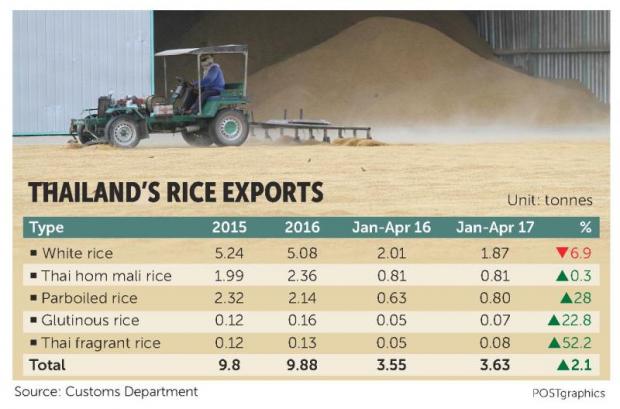
... From Jan 1 to May 9, Thailand exported 4.1 million tonnes, up 9% from the same period last year, worth US$1.74 billion (60.1 billion baht), up 6% in value'.
An article from Vietnam.net (May 30) which looks at an interesting study:
'A study conducted by the Institute of Policy and Strategy for Agricultural and Rural Development shows there are nine million rice farming households nationwide, but around 300,000 of them account for the bulk of Vietnam’s rice export volume.
Meanwhile, the nation has over 300,000 rice milling facilities, but a majority of them are small. But in Thailand, there are a mere 1,000 rice milling plants. Besides, Vietnam has around 100 rice exporters, but a mere 22 of them focus on China, one of Vietnam’s largest rice buyers.
Industry experts said these two hindrances had led to the global market share of Vietnamese rice shrinking. Statistics of the Ministry of Agriculture and Rural Development show the country’s rice shipments last year dropped 27% in volume and 23% in value against 2015'.
Meanwhile, a new weapon in the armory of Italy's rice industry hoping to target cheaper rice imports from Cambodia, Burma and potentially Vietnam. From Lexology.com (May 31):
'The Italian government has submitted to Brussels the draft decrees for the introduction of an obligation to indicate the origin of certain the raw materials.16 For rice, the place of cultivation, processing and packaging must be indicated, while for wheat, the place of wheat cultivation and the sowing of the seeds must be indicated. 
...
To try and counter the imports producers have been calling for better labelling of foodstuffs containing rice so as to indicate to consumers the true origin of the raw materials.
The producers hope that consumers will tend to purchase products with Italian rice rather than imported rice'.
It seems more as a message for domestic markets.

Measuring
Organics in Cambodia are poised to be government ruled. The Cambodia Daily (Jun. 1):
'The Agriculture Ministry will soon adopt a national standard for organic vegetable production to create product consistency and a single yardstick for farmers to work toward, according to officials.
A logo that will mark the products as government-approved organics has been designed, and a draft law by which the produce quality will be measured is nearly complete, said Kean Sophea, deputy director of the ministry’s department of horticulture'.
How will this work in practice? I doubt that this label would result in better trust by consumers than any other current logo.

Having access to the world market doesn't necessarily mean a positive. Hard work still needs to be done. The Vientiane Times (May 22):
'Although Laos is enjoying Generalised System of Preferences (GSP) exemption from over 50 nations around the world, the country is still unable to fully benefit from the special treatment.
The Ministry of Industry and Commerce recently described a number of challenges Laos is facing in order to fully benefit from trade privileges.
One of the most important points is that Lao businesses don’t fully understand the true benefits and the various procedures of the scheme.
In the meantime, product quality sometimes does not meet the standard requirements as specified by countries at the final destination. 
In addition, Lao businesses produce agricultural goods in small volumes as they are often family concerns and have not done any market research or studied the GSP'.  
More policy talk. The Phnom Penh Post (May 11):
'Cambodia's agricultural sector must improve post-harvest processing to increase the value of its products, while increased knowledge sharing could help farmers better understand the different value chains and identify opportunities, agricultural experts participating in the Grow Asia Forum said yesterday.
Panellists at the event, hosted by Grow Asia and held on the sidelines of the World Economic Forum (WEF) in Phnom Penh, also said improving farmers’ access to better seeds and inputs, as well as training, would help them to be more productive'.
More policy talk. I think. Phnom Penh Post (Jun. 2):
'Implementation of a previously announced three-year $20 million programme to increase local vegetable and fragrant rice production will begin next month to help boost domestic supply and reduce imports, an agriculture official said yesterday.
The goal of the project is to increase local production of vegetables by 160 tonnes per day and production of 500,000 tonnes of paddy rice a year, Kean Sophea, deputy director of the Department of Horticulture and Subsidiary Crops at the Agricultural Ministry, said'.
And then an article from the Phnom Penh Post (May 19) highlighting how agricultural policy can develop without government fiddling:
'The Kingdom’s leading palm oil producer has projected revenues of $20 million this year as it targets another record-setting year for crude palm oil exports.
“We plan to export over 30,000 metric tonnes of crude palm oil this year, with revenue of approximately $20 million,” Prachak Kongtanomtham, vice president of Mong Reththy Investment Cambodia Oil Palm Co Ltd (MRIC), said yesterday.
MRIC, a joint venture subsidiary of local agro-industrial conglomerate Mong Reththy Group and Thailand’s TCC Group, exported a record 21,450 metric tonnes of crude palm oil in 2016, generating over $13.3 million in revenue, according to Prachak. 
...
About 17,000 hectares of MRIC’s palm oil plantations are harvestable. Two other companies operate commercial palm oil plantations in Cambodia, though only one has matured to harvest.
Malaysian-owned Virtus Green Plantations (Cambodia) operates a palm oil plantation on a portion of its 6,700-hectare economic land concession in Kampot province. 
...
The Kingdom’s other major palm oil plantation is located in Ratanakkiri province, where subsidiaries of Vietnam’s Hoang Anh Gia Lai have planted oil palms on 18,000 hectares. The first harvest is expected by next year'.
Sweetener
The  Bangkok Post (May 24) reports of how Thailand seeks to meet free trade requirements while at the same time manipulating the domestic market:
'Thailand, the world's second-largest sugar exporter, is introducing regulations to govern its sugar trading system for the 2017-18 crop, which commences in November, to bring the system in line with World Trade Organization (WTO) rules.
...
Brazil says Thailand's subsidies for sugar producers had dragged down global prices and allowed Thailand to win a larger market share at the expense of Brazilian producers, conduct that is not in line with international trade agreements.
...

Traders and industry officials said freeing up domestic retail sugar prices could lead to possible sugar shortages, particularly when global sugar prices rise. Traders said sugar production costs in Thailand should be slightly lower than for net sugar importing countries. This could encourage profiteers to smuggle sugar from Thailand to be resold in the neighbouring CLMV countries (Cambodia, Laos,
Myanmar and Vietnam), where sugar prices are around 40% higher than domestic retail prices'.
Also hoping to dampen the local market the Bangkok Post (May 27) reports how stricter food rules will ensure that the domestic consumption will sky-rocket:
'A new bill imposing a maximum of 10% sugar or sweetener content in food products is expected to be passed and come into effect within this year, said the Food and Drug Administration (FDA) yesterday'.
The article also quotes EU regulation of the same subject. Though I doubt whether or not the EU has legislation on the subject, it's  certainly  clear that the EU sugar industry is very much opposed to any levels. Kudos to the Thai on this subject, let's hope it's an effective policy.

Then what an opener market means. The Phnom Penh Post (May 23):
'Cambodia's biggest sugar mill has finished its two-month production run, producing half a million tonnes of refined white sugar, nearly five times what the company predicted at the beginning of the harvest season, a company representative said yesterday.
Kuy Yoeurn, an administrative manager for Rui Feng (Cambodia) International Co Ltd, said the second harvest season of its $360 million sugar plant in Preah Vihear province greatly exceeded the company’s expectations. He said the mill produced 500,000 tonnes of refined sugar from an undisclosed amount of raw sugarcane this season.
...
The Cambodian government granted Rui Feng Cambodia an 8,841-hectare economic land concession (ELC) in 2011. However, the Chinese-owned company and its four sister companies collectively hold five separate ELC licences covering 40,000 hectares.
Rui Feng has faced accusations of land-grabbing and using its partner firms to circumvent restrictions on the maximum legal size of land a company can hold as an ELC.
Nevertheless, Yoeurn said Rui Feng has requested that the Ministry of Agriculture provide the company with more land to expand its cultivation of sugarcane.
“We need to increase our sugarcane cultivation,” he said. “So far, we have already farmed all of our land and it is still not enough. The ministry should provide us with more land for cultivation.”