Showing posts with label syngenta. Show all posts

Monday, June 5, 2017

Drenching

A short article to set us off. Previously highlighted here, it appears the EU are abating there strictness. Phnom Penh Post (May 31):
'Producers of white rice will have until September to meet the revised threshold level of 0.01 milligrams of Tricyclazole residue per kilo of rice, far below the current limit of 1 milligram per kilo, it said.
The previous deadline for white rice exports was June, while the December deadline for jasmine rice exports remains unchanged'.
It coincides with a recent article in Le Monde (May 29), which highlights how another chemical, atrazine, forbidden in the EU since 2004, still sees substantial production in the same EU with exports heading for countries with less scruples / less legislation. It cites the Swiss organisation Public Eye which in a recent report highlighted exports from Switzerland, France and Italy. On Switzerland: 
'Switzerland is exporting atrazine and paraquat to developing countries. The use of these herbicides, made by the Swiss-based Syngenta, has been banned in Switzerland due to their extreme toxicity'.
And though we're drifting off-topic, I would add the following article on banana growing in Laos. Often quoted, Reuters decided to make a write up. Excerptions of which are from VOA (May 11):
'Experts say the Chinese have brought jobs and higher wages to northern Laos, but have also drenched plantations with pesticides and other chemicals.
...
Under the "Belt and Road" plan, China has sought to persuade neighbors to open their markets to Chinese investors. For villagers like Kongkaew, that meant a trade-off.
"Chinese investment has given us a better quality of life. We eat better, we live better," Kongkaew said.
But neither he nor his neighbors will work on the plantations, or venture near them during spraying. They have stopped fishing in the nearby river, fearing it is polluted by chemical run-off from the nearby banana plantation.
...
Several Chinese plantation owners and managers expressed frustration at the government ban, which forbids them from growing bananas after their leases expire.
They said the use of chemicals was necessary, and disagreed that workers were falling ill because of them.
"If you want to farm, you have to use fertilizers and pesticides," said Wu Yaqiang, a site manager at a plantation owned by Jiangong Agriculture, one of the largest Chinese banana growers in Laos.
...
Hmong and Khmu workers douse the growing plants with pesticides and kill weeds with herbicides such as paraquat. Paraquat is banned by the European Union and other countries including Laos, and it has been phased out in China.
The bananas are also dunked in fungicides to preserve them for their journey to China'.
It just shows hoe the lack of a conscience is the underlying business rule with the large-scale agrochemical industry.

Stealth
With a slight upswing in the rice market, it comes as no surprise that the Phnom Penh Post (May 18) reports that big brother may well be interested in a bigger part of Cambodia's rice pie:
'China has agreed to increase its import quota for Cambodian rice to 300,000 tonnes by next year, Prime Minister Hun Sen announced yesterday following his return from Beijing where he attended the Belt and Road initiative summit'.
However the Khmer Times (Jun. 2) reports on the downsides on neighbouring actions:
'Cambodian rice millers and exporters are strongly concerned that Thailand’s plan to release 4.32 million tonnes of state rice stocks by September, driven by a sharp surge in global rice demand, could depress prices of the vital grain on commodity markets. “When Thailand sells such a large part of its stockpile on the open market it will have a knock-on effect on prices and in turn also affect the price of Cambodian milled rice exports,” Hun Lak, vice president of the Cambodia Rice Federation, told Khmer Times'.
The same source (Khmer Times, Jun. 5) also delves the depths of the marketing strategy of Cambodia's rice future:
'Government task forces will meet this week to finalise a single brand under which Cambodian rice will be exported.
...
Hean Vanhan, director-general of the general directorate of agriculture, said registration of a single rice brand was the duty of the commerce ministry. Agriculture officials said Cambodia had more than 10 varieties of fragrant rice, and should not single out one as a single brand.
“The CRF selected ‘Angkor Malis’ as the brand, but this is not right because there is already a rice seed called malis,” Mr Vanhan said.
“What the private sector wants to do is to steal foreign branding to make the rice similar to Thailand, since the Thai Hom Mali is already famous.
“If we use ‘Angkor Malis,’ which is specific only to Cambodian premium rice ‘malis,’ it has a different taste to Cambodian fragrant rice such as phka romduol, phka chansensor and phka khnei.
“If customers buy Angkor Malis one day, it may have a different taste when they buy it in the future, even though it carries the same brand,” Mr Vanhan said.
He suggested that a non-specific ‘Angkor Rice,’ with the specific variety written underneath would help clear up the confusion and prevent people from thinking they were buying a specific rice variety when they might be buying a different premium rice'.
Thai-tening
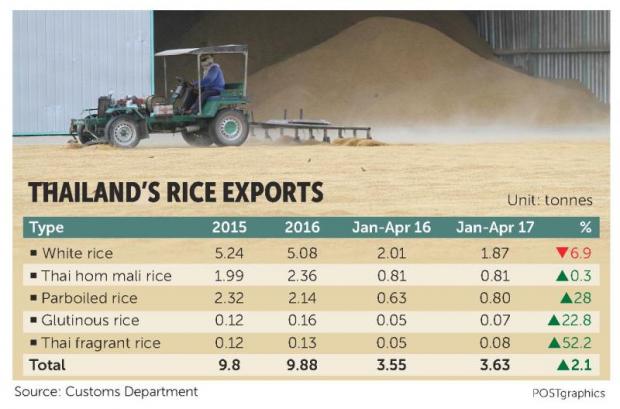
Regionally it's the Thai who are mostly optimistic. From the Bangkok Post (May 30): 
'World rice prices are expected to rise by US$20 (682 baht) a tonne over the next three months, driven by a sharp surge in global rice demand, according to experts. Global rice supply is now quite tight, while Thailand's previously hefty state rice stocks have eased, releasing pressure on global rice prices, Jeremy Zwinger, chief executive of the Rice Trader, said at the "World Rice Trade Outlook" seminar of Thailand Rice Convention 2017, held in Bangkok yesterday. 
...
Chookiat Ophaswongse, honorary president of the Thai Rice Exporter Association, said lower-than-expected rice production in Vietnam accounts in part for the lower global supply, while Thailand's good-quality rice stocks are about to be depleted.
 
From Vietnam a similar sentiment, though more cautious. The VNexpress (May 12):
'China and several African countries have returned to Vietnam seeking fragrant and white rice, and the demand has helped stabilize export prices even though supply has risen at the end of a major harvest, traders said on Friday'.
The Vientiane Times (May 5) notes that the Lao dry season rice crop may well disappoint slightly.
'This dry season, the department set a target of 95,000 hectares but until now only about 90,000 hectares have been planted out.
Department officials said a large number of farmers were now growing other crops instead, which earned them more money and required less water. The lack of irrigation occurred because provinces did not have sufficient funds to pay for the repair of irrigation systems, according to the Department of Irrigation'.
Thailand is looking to getting rid of the last of it's inventory. The Bangkok Post (May 16):
'The government yesterday called the second auction for 1.82 million tonnes of state-held rice that is fit for human consumption.
...
The government is estimated to hold about 4.82 million tonnes of rice stocks, a sharp drop from the 18.7 million tonnes accumulated during 2011-14. 
... From Jan 1 to May 9, Thailand exported 4.1 million tonnes, up 9% from the same period last year, worth US$1.74 billion (60.1 billion baht), up 6% in value'.
An article from Vietnam.net (May 30) which looks at an interesting study:
'A study conducted by the Institute of Policy and Strategy for Agricultural and Rural Development shows there are nine million rice farming households nationwide, but around 300,000 of them account for the bulk of Vietnam’s rice export volume.
Meanwhile, the nation has over 300,000 rice milling facilities, but a majority of them are small. But in Thailand, there are a mere 1,000 rice milling plants. Besides, Vietnam has around 100 rice exporters, but a mere 22 of them focus on China, one of Vietnam’s largest rice buyers.
Industry experts said these two hindrances had led to the global market share of Vietnamese rice shrinking. Statistics of the Ministry of Agriculture and Rural Development show the country’s rice shipments last year dropped 27% in volume and 23% in value against 2015'.
Meanwhile, a new weapon in the armory of Italy's rice industry hoping to target cheaper rice imports from Cambodia, Burma and potentially Vietnam. From Lexology.com (May 31):
'The Italian government has submitted to Brussels the draft decrees for the introduction of an obligation to indicate the origin of certain the raw materials.16 For rice, the place of cultivation, processing and packaging must be indicated, while for wheat, the place of wheat cultivation and the sowing of the seeds must be indicated. 
...
To try and counter the imports producers have been calling for better labelling of foodstuffs containing rice so as to indicate to consumers the true origin of the raw materials.
The producers hope that consumers will tend to purchase products with Italian rice rather than imported rice'.
It seems more as a message for domestic markets.

Measuring
Organics in Cambodia are poised to be government ruled. The Cambodia Daily (Jun. 1):
'The Agriculture Ministry will soon adopt a national standard for organic vegetable production to create product consistency and a single yardstick for farmers to work toward, according to officials.
A logo that will mark the products as government-approved organics has been designed, and a draft law by which the produce quality will be measured is nearly complete, said Kean Sophea, deputy director of the ministry’s department of horticulture'.
How will this work in practice? I doubt that this label would result in better trust by consumers than any other current logo.

Having access to the world market doesn't necessarily mean a positive. Hard work still needs to be done. The Vientiane Times (May 22):
'Although Laos is enjoying Generalised System of Preferences (GSP) exemption from over 50 nations around the world, the country is still unable to fully benefit from the special treatment.
The Ministry of Industry and Commerce recently described a number of challenges Laos is facing in order to fully benefit from trade privileges.
One of the most important points is that Lao businesses don’t fully understand the true benefits and the various procedures of the scheme.
In the meantime, product quality sometimes does not meet the standard requirements as specified by countries at the final destination. 
In addition, Lao businesses produce agricultural goods in small volumes as they are often family concerns and have not done any market research or studied the GSP'.  
More policy talk. The Phnom Penh Post (May 11):
'Cambodia's agricultural sector must improve post-harvest processing to increase the value of its products, while increased knowledge sharing could help farmers better understand the different value chains and identify opportunities, agricultural experts participating in the Grow Asia Forum said yesterday.
Panellists at the event, hosted by Grow Asia and held on the sidelines of the World Economic Forum (WEF) in Phnom Penh, also said improving farmers’ access to better seeds and inputs, as well as training, would help them to be more productive'.
More policy talk. I think. Phnom Penh Post (Jun. 2):
'Implementation of a previously announced three-year $20 million programme to increase local vegetable and fragrant rice production will begin next month to help boost domestic supply and reduce imports, an agriculture official said yesterday.
The goal of the project is to increase local production of vegetables by 160 tonnes per day and production of 500,000 tonnes of paddy rice a year, Kean Sophea, deputy director of the Department of Horticulture and Subsidiary Crops at the Agricultural Ministry, said'.
And then an article from the Phnom Penh Post (May 19) highlighting how agricultural policy can develop without government fiddling:
'The Kingdom’s leading palm oil producer has projected revenues of $20 million this year as it targets another record-setting year for crude palm oil exports.
“We plan to export over 30,000 metric tonnes of crude palm oil this year, with revenue of approximately $20 million,” Prachak Kongtanomtham, vice president of Mong Reththy Investment Cambodia Oil Palm Co Ltd (MRIC), said yesterday.
MRIC, a joint venture subsidiary of local agro-industrial conglomerate Mong Reththy Group and Thailand’s TCC Group, exported a record 21,450 metric tonnes of crude palm oil in 2016, generating over $13.3 million in revenue, according to Prachak. 
...
About 17,000 hectares of MRIC’s palm oil plantations are harvestable. Two other companies operate commercial palm oil plantations in Cambodia, though only one has matured to harvest.
Malaysian-owned Virtus Green Plantations (Cambodia) operates a palm oil plantation on a portion of its 6,700-hectare economic land concession in Kampot province. 
...
The Kingdom’s other major palm oil plantation is located in Ratanakkiri province, where subsidiaries of Vietnam’s Hoang Anh Gia Lai have planted oil palms on 18,000 hectares. The first harvest is expected by next year'.
Sweetener
The  Bangkok Post (May 24) reports of how Thailand seeks to meet free trade requirements while at the same time manipulating the domestic market:
'Thailand, the world's second-largest sugar exporter, is introducing regulations to govern its sugar trading system for the 2017-18 crop, which commences in November, to bring the system in line with World Trade Organization (WTO) rules.
...
Brazil says Thailand's subsidies for sugar producers had dragged down global prices and allowed Thailand to win a larger market share at the expense of Brazilian producers, conduct that is not in line with international trade agreements.
...

Traders and industry officials said freeing up domestic retail sugar prices could lead to possible sugar shortages, particularly when global sugar prices rise. Traders said sugar production costs in Thailand should be slightly lower than for net sugar importing countries. This could encourage profiteers to smuggle sugar from Thailand to be resold in the neighbouring CLMV countries (Cambodia, Laos,
Myanmar and Vietnam), where sugar prices are around 40% higher than domestic retail prices'.
Also hoping to dampen the local market the Bangkok Post (May 27) reports how stricter food rules will ensure that the domestic consumption will sky-rocket:
'A new bill imposing a maximum of 10% sugar or sweetener content in food products is expected to be passed and come into effect within this year, said the Food and Drug Administration (FDA) yesterday'.
The article also quotes EU regulation of the same subject. Though I doubt whether or not the EU has legislation on the subject, it's  certainly  clear that the EU sugar industry is very much opposed to any levels. Kudos to the Thai on this subject, let's hope it's an effective policy.

Then what an opener market means. The Phnom Penh Post (May 23):
'Cambodia's biggest sugar mill has finished its two-month production run, producing half a million tonnes of refined white sugar, nearly five times what the company predicted at the beginning of the harvest season, a company representative said yesterday.
Kuy Yoeurn, an administrative manager for Rui Feng (Cambodia) International Co Ltd, said the second harvest season of its $360 million sugar plant in Preah Vihear province greatly exceeded the company’s expectations. He said the mill produced 500,000 tonnes of refined sugar from an undisclosed amount of raw sugarcane this season.
...
The Cambodian government granted Rui Feng Cambodia an 8,841-hectare economic land concession (ELC) in 2011. However, the Chinese-owned company and its four sister companies collectively hold five separate ELC licences covering 40,000 hectares.
Rui Feng has faced accusations of land-grabbing and using its partner firms to circumvent restrictions on the maximum legal size of land a company can hold as an ELC.
Nevertheless, Yoeurn said Rui Feng has requested that the Ministry of Agriculture provide the company with more land to expand its cultivation of sugarcane.
“We need to increase our sugarcane cultivation,” he said. “So far, we have already farmed all of our land and it is still not enough. The ministry should provide us with more land for cultivation.”

Wednesday, February 24, 2016

Obsession

Not excessively much to share this update. And less so on regional rice issues.

The main news on the globe's hybrid news is an issue which touches on hybrid rice currently but certainly is setting the scene for the future of hybridisation and development of GMO's.

The issue is of course China's ChemChina intent to purchase Syngenta for a substantial sum, one shareholders can not refuse apparently. 
Syngenta itself has hedged a bet on hybrid rice (Devgen) and is also known for promoting seed coating chemicals in combination with hybrid rice (source). 
Oddly, Syngenta is at the heart of a trade dispute with China as for 3 years large imports to China of GM corn were undertaken without the granting of a no  objection of the GM source (source). Which ultimately meant that this trade fell away for US farmers.

Not quite unsurprisingly, there's now even a counter bid (lead by Monsanto), as the U.S. don't feel comfortable with selling of technologies to China ... (source).

Wired.com (Feb. 18) has an article on this proposed takeover.
'Food security is a national obsession [for China] —so it only seemed natural when, earlier this month, state-owned ChemChina announced its bid to buy the pesticide- and seed-producing giant Syngenta, in what is likely to be the biggest acquisition in the country’s history. Technology, the Party seemed to say, and especially genetically modified crops, are the key to a sustainable future.
There’s just one problem: Most Chinese hate GMOs.
...
And while China will bar Syngenta from bringing GM crops to market in the country, the company will very quickly be able to sell things like hybrid rice strains'.
Let's continue in this vein. 
While hybrid rice was hailed as the forefront of the new green revolution, the reality has been that the returns (to farmers and consumers) are few and far between. 
But not to worry, the second green revolution has yet again finally arrived. Genome sequencing technology is apparently all the rage. ThBangkok Post (Feb. 15) has an article pinning on revolutionary hopes:
'With the huge pool of data unlocked, rice breeders will soon be able to produce higher-yielding varieties much more quickly and under increasingly stressful conditions, scientists involved with the project told AFP.
Other potential new varieties being dreamt about are ones that are resistant to certain pests and diseases, or types that pack more nutrients and vitamins'.
Now, there are only marginal gains to be made by this. These gains are mostly in the conventional breeding such that it may enable breeders to breed varieties more adaptable to changing climate conditions and / or variations in disease control. 
But it's certainly far from the hailed second green revolution and has little to offer in terms of food security where government controlled storage is the best option to maintain market control.

Then let's finalise the rice news with this.  
Bangkok Post (Feb. 1) mentions how rice prices going down are a ticking time bomb. Basically it's part of an act to scandalise the previous democratic government as it's rice pledging scheme failed to add up. But nowhere near a ticking time-bomb. Pity this comparison.

Granted
Then it's time to look at the other crops of Cambodia section. 
Pepper retains it's allure to farmers and things are looking good with crop section development and cooperation. This  by Phnom Penh Post (Feb. 20):
'The European Union has officially entered the name “Kampot pepper” into its register of protected designations of origin and protected geographical indicators, the EU’s official gazette reported this week'.
Odd news from the Cambodian sugar front. 
After past large scale efforts to set up an industry with export sights set on Europe turned sour, an inauguration will take place of a new project. This time backed by Chinese investment and focusing on ... exporting to the EU. 
So reports the Phnom Penh Post (Feb. 4). The supposedly massive project has also more similarities with prior efforts to set up a Cambodian sugar industry:
'The government granted Rui Feng a 8841-hectare ELC in 2011 for the cultivation of sugarcane, rubber and acacia. The total land area was subsequently trimmed by about 1,000 hectares in an effort to settle disputes with those living on the land.
The company has faced ongoing protests from villagers and indigenous hill tribes, who accuse it of land-grabbing.
The adjacent ELCs are owned by Rui Feng’s sister companies, Lan Feng, Heng You, Heng Rui and Heng Nong. Collectively the Chinese-owned companies hold five separate ELC licenses covering a total of 40,000 hectares, effectively circumventing legislation that prohibits a single company from holding more than 10,000 hectares'.
Despite open markets all the rage and tariffs going to zero, it's especially non-tariffs that are making trading difficult. The Phnom Penh Post (Feb. 20) remarks this on cassava:
'... Thai authorities have replaced tariffs with a raft of non-tariff barriers aimed at stemming the flow of Cambodian-grown cassava across the border by notching up its shipping costs to discourage trade. In recent months, Thai border officials have shown a conspicuous zeal in enforcing weight restrictions on cassava-laden trucks.
....
Thai border officials have honed in on another obscure regulation, measuring the quality and moisture content of the cassava cargo'.

Thursday, October 24, 2013

Fairy land

The mythical world
Prominent news the past few weeks is a nondescript article in IRRI's Rice Today.

IRRI is feeling the heat (Rice Today, Oct. 8) and responds to it's critics of the development of Golden Rice (GR). 

GR essentially implies adding genes to traditional varieties giving them higher vit. A traits. 
The myths of GR:  
'First is the notion that Golden Rice is some sort of unnatural, monster rice. 
...
Second is the idea that genetically modified organisms (GMOs) are unsafe, cause cancer or other major health risks, or pose serious environmental problems. 
... 
Finally, there is the idea that Golden Rice is being developed to be sold by big biotechnology companies to profit from poor farmers'.
But in reality it does nothing to allay these fears. See here:
- Approving GR is just a way to soften up resistance to hybrid and GM rice. 
- If GMOs are safe why is there so much public resistance? Why not approve labelling then, is this not a win-win solution?
- Well, big companies are all well versed in PR. Give a crumb here, reap the world there. Syngenta's involvement gives them some pay-back elsewhere with IRRI, for sure ...

Still, kudo's for IRRI facing the music.

Just an afternote: too close for comfort Bayer Cropscience has a big do in Delhi, India called ricefutureforum with IRRI as co-host and has also managed to get Germany's public development agency Giz on board ...
The future according to Bayer is a hybrid one. Yeah, right.

Oh and this. An interesting article from farmanddairy (Oct. 10) highlights recent research which focuses how herbicide resistance can pass from the GM crop to similar weeds: 
'Rice containing an overactive gene that makes it resistant to a common herbicide can pass that genetic trait to weedy rice, prompting powerful growth even without a weed-killer to trigger the modification benefit, new research shows'. 
Though this does not imply that it will happen obviously there may be more risks than we think.

Domestic and global affairs
There's surprisingly little to report on, in Cambodia.

Despite export figures up by 100%, it still falls way behind what the government would like to see (PPP, Oct. 9). Reality check.

Production will remain the same. Is this despite of the floods? Or because of the floods? Source is the Cambodian Herald (Oct. 4).

The Strait Times (Oct. 12) notes how India is becoming Singapore´s source of rice, leaving Thailand behind. No reasons given, is it the price? Consumer preference for Basmati? A miracle?

Some good news for Thai government. The Wall Street Journal (Oct. 14) highlights China's lower than expected rice production. Partly brought on by drought/heat conditions earlier this year it also delves up info on productivity which also is slipping: 
'Analysts cite a shift in land use toward industrial and residential by farmers in the humid southern regions where rice grows best. Production has increasingly moved to more arid northern regions where big yields are harder to get, said Rabobank agriculture analyst Chenjun Pan.
Ms. Pan and other analysts say the rice-yield plateau shows that affordable technological innovations to increase yields may have also reached their limits. Chinese academics have developed a strain of "super rice," capable of doubling the yield to 13.5 tons a hectare, but the hybrid grain remains financially out of reach for most farmers.
A trend of lower Chinese rice production, if sustained, would afford further opportunities to global rice exporters in what is becoming an increasingly attractive market. Overall grain imports are rising along with domestic wealth and worries over illegal levels of toxicity in many kinds of Chinese-produced food'.
More significant I found this snippet: 
'Grain imports in China are a politically sensitive issue. China's military has weighed in publicly against rising corn imports in recent months, with a major general from the People's Liberation Army publishing an essay in a popular newspaper in August arguing that genetically modified corn imports may be a way for the U.S. to threaten China's food security'. 
Well, if this is the view then the expansion of global hybrid rice fuelled in part by Chinese interests might well imply that the intentions need not be humanitarian, nor economic. But a way to strategically gain leverage? Hidden agenda?

The FAO put out another of their quarterly overviews of the world's cereal markets (Oct. 3). It notes the continuing fall of rice prices and the slow expansion of production. The immediate future sees prices going lower yet, not really encouraging for any producers.

And the saga continues
The Nation (Oct. 1) mentions that maybe the Thai rice pledge will continue indefinitely as losses are nowhere near what everybody thinks.

The institutionalizing of the programme has required a need for more storage capacity. The Bangkok Post (Oct. 1) reports on how the Thai state Public Warehousing Organisation hopes to be able to expand compensation. 
However they are up against fraud suspicions as in their previous attempt to expand, the bid winner was announced before the tender process started ...!

Even though exports have dropped since the start of the rice pledging scheme, the Thai government is still comfortable with the ability to export 8-10 million tonnes. So mentions the Nation (Oct. 9).
Funny, to date export volumes for 2013 are nearly 2.5 million tonnes, down more than 30% on the 2012 figures. Let's see where the 8 million come from.

Accounting for losses means that the government hopes to not include humanitarian assistance in it's books, i.e. this should be a write off at full purchase price, rather than the world market price. Who cares? The Nation, Oct. 10.

The accounting section was also at a loss to find out that they had actually bought more rice in the past 2012-2013 season than intended and need another 9 billion Thai Baht (nearly 0.3 billion $US), so reports the Bangkok Post (Oct. 10). Why not?

A blog entry by the Wall Street Journal. Posted on Oct. 7 it gives a good introduction to current issues on the rice pledging scheme. However it also mentions to instil it's own philosophies. For instance it mentions that continuation of current government policies is ill-advised and will lead to increased dissatisfaction with the government. Me thinks the opposite.

Spin doctoring at it's best. A Thai government official notes that food insecurity issues are driving those affected countries into Thai arms and will receive nice quantities of rice imports if they ask politely. 
Or so it seems. 
Reported in the Nation (Oct. 14) it implies that storing most of the globe's exports will result in positive paybacks for the service offered. But what if over-priced in a climate where prices are trending downwards?

The Bangkok Post provides us with news: rice pledging leads to lower global prices (Oct. 15). Nothing new. Stocks in Thailand will increase, by 24% so estimates the USDA. Global prices will drop by 10% by April next year. In the article it refers to Bloomberg's article of 15 Oct. 2013.

Thailand's BAAC needs another 140 billion bath ($4,.5 billion US$) to finance next years pledges, so reports Bangkok Post (Oct. 21). Hope somebody is adding all this up.
 
Bangkok Post (Oct. 11) repeats Thai government assertions that it will be able to sell 1 million tonnes of rice to China. Spread over 5 years ... And bought from private traders not the government. And the same article notes that previous government claims appear to be wishful thinking.

The deal with China is preliminary, concedes Thai PM (Bangkok Post, Oct. 16). Apparently it's just an intention. Salient detail: there might be swap, rice for high speed trains! 
The Nations mentions that exporters are in no mood for cheering (Oct. 15) despite announcements of deals with China. It also notes that the Thai PM is vague on details (Oct. 16). While a day later the Bangkok Post emphasizes the PM implied the agreement was an informal one, i.e. no deal at all. Opposition were making hay with implying the government were imagining deals.

At a loss
Coming from another corner, a former Deputy PM (Pridiyadhorn Devakula) advises the government to hand out the cash directly to the farmers rather than establishing an intricate and fraud-fraught system based on producing rice (Bangkok Post, Oct. 15). 
On the face of it, it does seem more just, but in the end the only thing that ties recipients into the slower growing areas is the production of rice. Fail to reward agricultural production would result in everyone moving into Bangkok and using proxies to earn their share of the pie. Now at least there is some multiplier effect and if the scheme had been introduced before the height of rice prices it would have produced quite an effect. However now the scheme is draining public funds, encouraging fraud while it may well be never-ending.
Bite:
'He [Pridiyadhorn Devakula] cited figures showing that in the two years since implementing the programme, with a total of 48 million tonnes of paddy involved, the government had lost at least 425 billion baht, but rice farmers gained benefits amounting to only 210 billion baht.
More importantly, those who were not farmers gained more than 115 billion baht in benefits, showing that the government had failed to prevent corruption in the rice scheme, he said'. 
High in pointing out current short-comings there seems to be little thought of over how an alternative plan would work, nor how fraud might be avoided. 
As always the Nation chimes in likewise. Or is it vice-versa?

Government refutes Pridiyadhorn Devakula claims. The Nation (Oct. 17) gives air to government rebuttals: nobody knows what the losses are! Not even the government!

Despite assurances to the contrary, former deputy PM / Finance minister (Pridiyadhorn Devakula) sees losses only going up (Bangkok Post, 22 Oct.). The neat sum of losses would be 466 billion baht or nearly 15 billion $US since it's induction.
'Last week, MR Pridiyathorn, also known by his nickname of Mom Oui, gave a press conference in which he called the government's rice-pledging scheme the biggest loss-incurring project ever conceived. At the time, he estimated that if the government could sell all of the pledged rice stockpiles by 2015, it would make losses of at least 425 billion baht _ 205 billion baht from the 2011/2012 crop and 220 billion from the 2012/2013 crop. MR Pridiyathorn's comments prompted government ministers to defend the project. Finance Minister Kittiratt Na-Ranong said MR Pridiyathorn, also a former governor of the Bank of Thailand, does not understand the programme's accounting system. Deputy Prime Minister Niwatthamrong Boonsongpaisan, who is also commerce minister, said actual losses from the scheme as of January were only about 100 billion baht. In response to MR Pridiyathorn's latest estimates, Deputy Commerce Minister Yanyong Phuangrach yesterday said it was impossible for the rice scheme to cause as much as 466 billion baht in losses. He said the government has spent about 600 billion baht on the project. It expected to earn 200 billion baht from rice sales by the end of this year. "That means there is a gap of 400 billion baht. But we have more than 10 million tonnes of rice in stock. Even if we sell the rice at half price, we would still earn about 200 billion baht," Mr Yanyong
insisted. He added that his calculation means the government will be only about 200 billion baht short, which amounts to a loss of about 100 billion baht a year. MR Pridiyathorn insisted yesterday that number was impossible based on the rice release information from the ministry itself. "It's clear the ministry's argument is completely wrong. The issue is whether the ministry understands the issue but conceals the loss figures, or if it does not understand anything," MR Pridiyathorn said'.
Alt
Some rice not going into the rice pledge scheme is organic rice. The Bangkok Post (Oct. 14) reports on how a Singaporean entrepreneur is importing into Singapore as well as exporting to other markets northern Thai organic rice priced at 10% above the governments pledging prices. Business is expanding by 10% per annum with current exported quantities heading towards the 1,000 tonnes. 
The Nation carries the same story.

The Nation (Oct. 21) concludes that organic rice is better than feeding off the national rice pledge scheme. Another feel good story about how organic rice has the potential to avoid pitfalls of the industrial lead rice schemes, i.e. by avoiding taking on debt. Pity the story from Thailand's Khon Kaen is scarce on economics.

Thursday, October 18, 2012

Premium

Keeping up to date with hybrid rice developments especially in Southeast Asia is not really an enduring task. However if the price of rice is tantamount, it means following the rice pledging saga of Thailand (see below).

But let's start with some company news. 
Devgen, the Belgian rice-hybrid pioneer, is being gobbled up by Syngenta (Bloomberg, 21 Sept.). Price is just over US$ 520 million, including a 70% premium! The logic behind is a gamble. But as competitors such as Bayer and BASF are already ahead in the game, it's a not a question of why not to step in, but when. Now.
Interesting is that the major players are looking more into pipeline technologies, so as to be able to combine hybrids with their own produce. They are not in the seed business. Or else a company such as SL Agritech may well have been purchased ....
Hybrid hype? SL Agritech will team up with Capital Rice of Thailand to produce hybrid rice in Burma. SL will provide technical input, Burma the cheap land/labour and poor legislation while CR will market the produce ... If all would be so wholesome, why the need to obtain land in Burma?

Local news
Another deal done with China (Phnom Penh Post (PPP), 5 Oct.). But is it a deal done? 

Rice registration? The PPP (4 Oct.) treats it's readers to an unclear article. Or is the proposed policy unclear?
'In an effort to promote rice exports among Cambodian farmers, government officials said on Tuesday they will register the type of rice seed set for export and the rice seed produced for the national market'.

Well, the Arab Emirates are not buying in Thailand, but according to the PPP (2 Oct.) they may well want a slice of Cambodia's rice cake. The good news:
'Kim Savuth [Chairman of the Federation of Cambodian Rice Exporters] said he already conducted a study about the Arab market last year.
“I found out that they are not strict on the quality of milled rice,” he said'. 
Let's hear it for not strict. The bad news? The articles title is misleading [UAE asks for more rice], it´s Cambodia wanting to push their produce ....

Cambodia = World's Best Rice? According to the World Rice Conference, Cambodia was the winner. From Oryzae.com.

Not directly rice, but PPP (27 Sept.) reports that transport costs remain high in Cambodia:
'The comparison found Cambodia’s free on board (FOB) costs were US$ 35 a tonne, whereas Thailand and Vietnam costs per tonne were $17 and $16 respectively'. 
That's more than double. 
'PCF’s comparison shows that poor logistics and infrastructure make Cambodia not only more expensive but also less efficient than its neighbours'.
Organic rice? PPP reports (26 Sept.) that 
'Five metric tonnes of certified organic rice — the first such shipment from Cambodia — will depart for the European Union this Friday'. 
Organic not only refers to the method of growing, but also to the miller. 
'“For insect and vermin control, we avoid using poisons. In terms of catching mice and rats, we set traps rather than risk contaminating the paddy by poisoning them,” he [Green Trade chairman and director-general Virak Thon] said'. 
I hope they he is not implying that non-organic rice contains rat poison?

Laos has decided that it's farmlands are worth protecting. In line with some other Southeast Asian countries (the Philippines?), changing the land use of paddy field to anything other than that may become more difficult. According to the Vientiane Times (9 Oct.): 
'If the proposed regulation goes ahead, it will prohibit the converting of agricultural plots which have been surveyed and allocated for agricultural production purposes, for non-agricultural usage'. 
Considering that the intention is sustain food security they will have to limit this to rice paddies, me thinks ... 
And what if the enlighten folk of Lao PDR manage to steer this through? A venomous and embarrassing (to the Lao officials) piece of writing is to be found on New Mandala. In the article, the author goes to lengths to scratch the veneer and delve the depths of just one land removal (= land-grab), albeit the most famous, that of Vientiane's Don Chan gardens. A must read.
One way of dealing with land-grabs is to call on consumers. For instance CropWatch mentions (on Sept. 11) that Cambodia activists (read mostly non-Cambodians, but with their hearts in the right place) are trying to garner international attention.
'Human rights monitoring groups and Cambodian activists are calling for an international boycott of Tate & Lyle and Domino Sugar, who do business with sugar suppliers accused of participating in government-sanctioned land grabs and illegal evictions throughout rural Cambodia'.
To pledge
We now have a tedious listing of the past months newsworthy pieces concerning Thailand's rice-pledging system. 

Recap. On the face of it, the main factors are all too simple. For political reasons the government seeks to intervene in the market, i.e. acting as wholesale buyer at preferable rates. Fine for farmers, everybody now knows the rate and it means less fluctuation in price (so better to forecast returns). The government then needs to act on what they have purchased, it's stockpile. Because of the favourable price, the stockpile is bigger than the estimate. But governments are poor market players. Possibly they could sell easily in an market with increasing prices, but with prices remaining the same or dropping they need to use their non-existent business acumen. 
In the meantime, competition (from other countries) will be making hay. With little or no effort, their produce will have increased in price (the supply has been choked) while volume will also have increased.
See here the winners (traders and farmers all over the globe) and losers (Thai government / taxpayer; tank u!)

But in practice the rice-pledge scheme has now become a daily battle front with traders and the Thai opposition on one side and the government on the other. What here follows is just the last 3 weeks worth of reports: 
  • The government will continue the rice pledging scheme according to Bangkok Post (BP), 20 Sept.: 
    'A recent opinion poll showed farmers appeared to be supporting the programme. It was found that 86.5 per cent of farmers surveyed wanted the government to implement either a price-pledging or a price-subsidy scheme. And more than 35.4 per cent of the respondents said they were more satisfied with the price-pledging option because they could get more money and get paid faster'.
  • 22 Sept., BP
    'MR Pridiyathorn [former deputy premier and finance minister] is one of the key people campaigning against the rice pledging scheme as he believes it will "cost the country a huge loss".
    Discussion has forty plus reactions ...
    On 11 Oct. BP reports though that the legal challenge has been lost ...
  • Nation (22 Sept.): Traders question goverments estimates:
    'Was the projection based on the total pledging volume this year? And how can the government prove that all that rice seed is Thai?'
  • BP (24 Sept.) gives air-time to former PM Thaksin: Rice-pledging is a good thing. Example: 
    'Southeast Asia's second-biggest economy expanded 4.2% in the three months through June from a year earlier, exceeding all 16 forecasts in a Bloomberg News survey that had a median prediction of a 3.1% rise. The rice policy "helped boost the economy in the first and second quarter," Arkhom Termpittayapaisith, secretary-general of the National Economic and Social Development Board, said on Aug 20'.
  • Thai Central Bank advises against extending rice-pledging programme (Nation, Oct. 3). 
  • BP (4 Oct.) lets PM respond
    'Ms Yingluck said Tuesday the rice pledging programme was aimed at helping rice farmers and the rising incomes of farmers would eventually stimulate the national economy'.
  • BP reports (on Oct. 9) that a 'panel' has uncovered fraud. A mish mash, including: 
  • '... about 200 tonnes of rice smuggled into Sa Kaeo from a neighbouring country has been confiscated. Authorities suspect the owners of the rice intended to sell it under the pledging scheme as domestically produced paddy. A probe has started'. 
    Yet again, forty plus reactions.
  • The Nation (Oct. 9) notes that the Agricultural Bank needs to top up on cash for pay-outs to farmers. It also lists the whole discussion once more. Including this: 
    'The government believes that when Vietnam sells its rice, the price of Thai rice will automatically rise'.
    That will be the day ...
  • Then it gets weird. BP (10 Oct.): 
    'Officials who implement the government's controversial rice pledging scheme could be damaging the country and risk being taken to court, a senior economist from the Thailand Development and Research Institute (TDRI) has warned. 
    ... ... claims the rice pledging scheme is a breach of the constitution as it causes market distortions and disrupts normal trading practices'. 
    The end of government?
  • The Nation (10 Oct.) meanwhile lists the winners and losers. 
    'An exporter source said the country's top five rice exporters - with the exception of Siam Indiga  - have faced export drops in terms of both volume and value by an average of 40-50 |per cent. 
    ... 
    According to reports from Thailand's Foreign Trade Department and Customs Department, during the first seven months of this year, rice exports to Indonesia have dropped significantly by 52.61 per cent to 297,640 tonnes; to the Philippines by 99.85 per cent to 246,000 tonnes; to Bangladesh by almost 100 per cent to 58,000 tonnes; to China by 65.8 per cent to 65,003 tonnes; and to Ivory Coast by 46.24 per cent to 173,014 tonnes. Remarkably, those markets have been named by the government as its key buyers under government-to-government contracts'.
  • Sales might have taken place according to BP (12 Oct.): 
    'Mr Boonsong [Commerce Minister] has claimed the government has signed contracts to export 7.3 millions tonnes of rice under the controversial pledging scheme, though critics question whether the deals exist and have called for evidence.
    Addressing a press conference yesterday, Mr Boonsong provided only slightly more information than he had previously. The minister was ordered by Prime Minister Yingluck Shinawatra to disclose "as much as possible" on the G-to-G deals so that the public might better understand the much-criticised pledging scheme'.
  • Topping off (BP, 13 Oct.):
    'The use of a cargo terminal at Don Mueang airport to store pledged paddy has become the latest headache to hit the government's controversial rice pledging scheme.
    ... 
    The reason the government had to store the pledged rice for the time being was not because it had a problem with exporting the product but because it needed to wait until rice prices improved in the world market, he said'.
  • Then there is the Nation's (11 Oct.) own wrap-up. Excerpts: 
    'On the subject of Thailand's rice policy, many will agree that raising the price of rice is a good thing as long as it is not so high that Thailand prices itself out of the market completely. Unfortunately, that is increasingly the case
     ... 
    But poor Thai farmers won't know what to do or who they can turn to when the sky falls, as their government's policy has completely destroyed the very mechanism that has successfully sold their crops all these years'.
What is clear is that government involvement is thwart with so many potential disasters, even if in hindsight the original objectives are achieved, upsetting the market chain is hardly going to have a positive outcome. One wonders if simply handing out the cash might have been a better way of supporting the rural poor ... 

Interesting is the discussion on Thaivisa. Q:
'How Much Does A Thai Rice Farmer Receive Per Kg ? ?'
A:
'The only person I know whose wife is a rice farmer got 12,000 baht per ton of rice up here in Khampaeng Phet province instead ot the "promised" 15,000 baht.
Not too bad in a way as it was "only" a 20% ripoff instead of the usual 30 or more %.

...
Last year the wife decided to sell some of her rice to get the governemnt price which I think was supposed to be 20B/kg. Anyway first she had to have her land papers as only people with proper chanote title could claim. So she loaded up the truck, about 3 tonne, and headed to the local major rice buyer, there are several but only one that buys for the goverment scheme.  Gets there at about 8am takes a ticket and finally gets to be the second last load to be taken for the day at just before 4:30pm.  They take a sample and tell her, "too much red rice, no good, can't buy" so she brings it home. Next day she heads off to the smaller buyer she normally goes to and he pays her 14.5B/kg'.
Oh, and by the way, Laos now wants to do the same. Vientiane Times (25 Sept.) reports the following: 
'The government is proposing that, during the wet and dry seasons of 2012-2013, the public and the authorities should buy paddy sticky rice from farmers or producers for no less than 2,500 kip per kg, and not over 3,000 kip per kg from the rice association, rice mill groups or other businesses'.
Odd, so it's just an advice, like hell that will work. Not. 
It also notes that last year policy: 
'... the government banned farmers from exporting rice, including to neighbouring countries, as it had caused an unacceptable spike in the price of rice'. 
So is the price too high or to low?

Prices
Interestingly, ODI mention that 
'Unlike stocks held in China and India that are unlikely to be exported, those held by Thailand are such a strain on warehouses and finances, that at any sign of rising rice prices, they will probably be offloaded on the world market. They are therefore a significant insurance against rice harvest failures'. 
So the Thai are doing global consumers a favour!