Don't know whether or not this update affords a lead, it's very much a mixed bag with unusually long quotes. It's mostly what's not rice, that's interesting.
However let's start by looking within the Khmer kingdom. The Phnom Penh Post (Jan. 6) kicks off with a review of last years rice exporting efforts:
'The growth of rice exports slowed to a crawl last year, according to
new data, signalling that government initiatives to increase the
competitiveness of Cambodia’s mainstay crop had fallen short and raising
concerns about the future of the agricultural sector.
According to data received from the Ministry of Agriculture
yesterday, Cambodia’s rice exports totalled 542,144 tonnes last year, a
mere 3,700 tonnes, or 0.7 percent, more than the country shipped in
2015. The nominal increase followed a growth spurt in 2015 that saw
exports climb by 39 percent that year.
...
Hun Lak, vice president of the Cambodian Rice Federation, said 2016
proved to be an exceptionally challenging year for Cambodia’s rice
industry. He explained that local exporters had to compete with rival
rice-producing countries that were flooding the market with their
product, while local farmers struggled against low paddy prices
exacerbated by the sector’s shortage of capital and storage capacity.
...
Song Saran, CEO of Amru Rice, said looking back on 2016 exports, the
result was “acceptable,” but not satisfying. He said Cambodia’s supply
chain was flawed.
“Our supply chain is not balanced, as if you observe the export trend [during the course of the year] it is uneven,” he said.
“Our supply of rice paddy is limited at the beginning of the year, but we have an oversupply of paddy at the end of the year.”
Saran added that despite the high quantity of rice exported, the
commodity’s low price level was causing profits in the industry to
decline'.
'An Agriculture Ministry official said on Sunday that slowing growth in
Cambodian milled rice exports—increasing just 0.7 percent last year—was
the result of outdated policies and was a concerning trend.
...
Mr.
Vanhan [ministry’s director of the general directorate of agriculture]
said a new rice export policy was being formulated by the
Supreme National Economic Council, and would take into account the ways
the last five-year plan had failed.
He said last year’s drought
could not be blamed for the slowing exports, noting that the industry
had hit its target of producing 4 million tons of surplus rice. By
contrast, exports are still barely over half the 2015 target of 1
million tons'.
Rather than policies, it's poor market conditions that are to blame for the sluggish growth. Unfortunately the market will not change much in the year ahead.
The above were direct reports on the government data. They were as follows. AKP (Jan. 12):
'Last year, Cambodia exported 542,144 tons of milled rice to
international market, up 3,748 tons or 0.7 percent compared to the
amount in 2015, pointed out a report of the Ministry of Agriculture,
Forestry, and Fishery to Prime Minister Samdech Techo Hun Sen.
The Cambodian rice was exported to 65 countries, mostly to China
(127,460 tons), followed by France (78,329 tons), Poland (64,035 tons),
Malaysia (38,877 tons), the Netherlands (28,690 tons), Belgium (22,885
tons), Czech (22,815 tons), Italy (18,619 tons), UK (17,673 tons),
Germany (16,616 tons), it added.
If classified by region, EU remains the main buyer of Cambodian rice.
Last year, EU bought in total 341,066 tons or 62.9 percent of the
Cambodian exported rice, it underlined.
Currently, Cambodia has 85 rice exporting companies, most of them are local rice millers'.
To wrap up this first chapter, a curious posting from the Phnom Penh Post (Jan. 18):
'A Chinese company has unveiled a plan to establish rice production on
4,000 hectares of leased farmland in Takeo province, local media
reported yesterday.
The company said it would consider building a large rice mill on the
land to process up to 100,000 tonnes of rice a year for export to China.
It also unveiled a conceptual plan for a $100-million feed mill'.
Now we all have our doubts whether this will turn to reality, but can someone tell me why there is 4,000 ha farmland waiting for a company to be leased? Surely ensuring locals access to this, would be of a higher priority? Or has the investor been sold short?
Quitters
Cambodia's neighbors are faring none the better on the export market. Vietnamnetbridge (Feb. 3) highlights this by this article:
'Vinh Hoan Seafood Company has decided to quit rice production and export
though it spent big money on building a factory and choosing
high-quality rice sources for export.
Analysts said that Vinh Hoan made a reasonable decision. Many other rice
export companies took a loss in the last year, had to be dissolved or
kept operations at a moderate level. Many exporters reported a sharp
decrease of 40-45 percent in export volume in 2016 compared with the
year before.
...
Seventy-six percent of Vietnam’s rice is exported to Asian markets at
low prices, which explains why Vietnam can only obtain modest profits
despite high export volume, according to Kien. Meanwhile, more orders
have been placed with neighboring countries'.
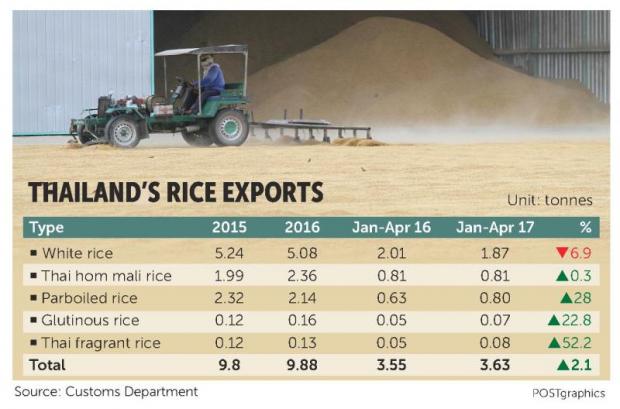
The news on rice exports from Thailand. The Bangkok Post (Feb. 4):
'Thai rice exports are expected to drop by 3.8% in volume this
year, with export prices likely to stay relatively low because of higher
global supply and stiffer competition.
The Thai Rice Exporters Association said shipments should reach
9.5 million tonnes this year, fetching US$4.3 billion or about 150
billion baht.
...
Sales
of premium hom mali rice are expected to climb 1.7% this year from 2.36
million tonnes last year.
Last year Thailand shipped 9.88 million tonnes of milled rice, up by
0.9% from a year before, valued at $4.4 billion. Thailand trailed only
India, which
exported 10.43 million tonnes last year, while Vietnam shipped 4.95
million tonnes'.
And the prospects are not much better. The Bangkok Post (Feb. 2):
'Rice shipments from Thailand, the largest supplier after India, are
likely to decline about 4% this year amid increased competition from
Vietnam and other producers.
...
Competition from Vietnam may cut white rice exports by about 400,000
tonnes to 4.6 million tonnes even as sales of premium jasmine grade rise
climb about 9% to 2.5 million tonnes, ...
...
World rice production will increase 1.6% to 480 million tonnes and
consumption will rise 1.5% to 477.8 million tonnes, according to the
USDA. Output from India, Thailand and Vietnam, the world’s top
exporters, will increase this season, data show'.
Though both Thailand and Vietnam seem to be seeing adversity ahead, Lao press sees silver linings in their rice export market albeit solely in that for organic rice. The Vientiane Times (Jan. 16):
'China has approved the purchase of 20,000 tonnes of organic rice a
year from Laos, according to Prime Minister Thongloun Sisoulith.
Mr Thongloun said in talks with Khong district
authorities in Champassak province last week that Chinese premier Li
Keqiang had agreed to the deal.
...
About 4,000 tonnes of sticky rice and nonglutinous rice has already been
delivered to China, and this year the shipment was to be 8,000 tonnes'.
The same source (Jan. 30) has more:
'Savannakhet and Champassak provinces may soon be producing about 40,000
tonnes of so-called 'clean', organic rice for both local markets and
export.
Deputy Director of the provincial Agriculture and Forestry Department, MrViengsaySipraphone, told Vientiane Times on
Friday that present estimates suggest that about 40,000 tonnes of rice
will be harvested in Savannakhet and Champassak, although the figure may
differ in practice.
...
An anonymous official in Savannakhet said that about eight countries
from the EU as well as China are importing 'clean' rice from the
province. Savannakhet is growing clean rice for export to the EU and
China, he said'.
Sunrise
In seeking alternatives the Thai junta is hedging it's future on their so-called megafarms. The Bangkok Post (Jan. 16):
'The government is committed to ramping up the rice megafarm scheme
this year, for which it provides soft loans, machinery and agricultural
equipment to farmers in order to cut production costs and raise productivity. The scheme will cover 1.05 million rai of related farmland.
...
The megafarm project implemented last year entails participating farmers
pooling their rice farmland together into one large plot, after which
modern equipment, including harvesting machinery, is deployed.
Participating farmers can borrow up to 5 million baht at 0.01%
interest from the Bank for Agriculture and Agricultural Cooperatives
(BAAC), while the Commerce Ministry is responsible for the marketing and
sales of the rice and finding buyers.
Acting as a group, participating farmers can negotiate for better
access to markets and financial resources such as loans. This grouping
and joint management is intended to ensure efficiency in the entire rice
business -- from planning to farming and marketing to distribution.
...
Ms Chutima, a former permanent secretary for the Commerce Ministry,
said the ministry will also focus this year on more actively promoting
food safety and security and good agricultural practices (GAP) in the
farm sector.
"One of the ministry's top priorities this year is to promote the
proliferation of GAP so that we can declare to the world in the future
that Thailand is a supplier of safe agricultural products such as
vegetables to the world," said Ms Chutima. "Although chemicals are used
while farming, it requires a long-enough period before harvesting and
the residue levels must be at a tolerable rate. This, once achieved,
will lead Thailand to the next step of development: chemical-free
farming and ultimately organic farming."
So if the future lies ahead, why then does the future also seem behind us? I mean 50 odd years ago, everything was organic. Then we nuked this with fertilizers and chemicals, just to learn that this might be just one big mistake.
'The
government aims to cut rice production to 27.2 million tonnes
of paddy from an average of 33 million tonnes a year, shrinking the rice
plantation area to 60.6 million rai from 68 million as part of its
agricultural reform. Tanit Anakewit, deputy permanent secretary to the
Agriculture and
Cooperatives Ministry, said farming in inappropriate locations produced
low-quality rice, mainly during the second crop, and such areas will be
encouraged to grow other crops.
...
Mr Tanit said the government's rice megafarm scheme is a move in the right direction as it cuts farmers' production costs.
The megafarm project provides soft loans, machinery and agricultural equipment to farmers to cut production costs and
raise productivity. It was implemented last year and participating
farmers pool their farmland into one large plot, using modern
equipment to harvest.
...
Somporn Isvilanonda, a senior academic from the Knowledge Network
Institute of Thailand, suggested the government concentrate more on hom
mali rice development, noting how Thai premium hom
mali rice has been losing its aromatic quality because of improper
cultivation processes.
The government is also being urged to promote growing coloured rice and
organic rice that can fetch higher prices and faces less competition'.
'Best
known for its historical sites, Sukhothai has introduced a
new attraction, a 1,200-rai field of blossoming yellow Indian hemp,
grown by farmers to replace second-crop rice. Suchart Rianthong,
Sukhothai land development director, said
farmers could bury Indian hemp plants to make natural fertiliser for
their future rice cultivation. Besides, they could sell hemp seeds at 20
baht per kilogramme to the local land development office and receive a
500-baht subsidy per rai from the government'.
And it also attracts tourists.
Juicy
There's quite a lot of non-rice agricultural news from Cambodia, mostly concerning market niches.
The Phnom Penh Post reports on mango exports (Jan. 17):
'Sweet and juicy mangoes grown in Cambodia have been finding their way
into top Asian markets for years, but until now only through Thai and
Vietnamese brokers, and often repackaged or processed into juices and
jams to disguise their Khmer origin.
Local producers’ lack of modern processing and packaging equipment
meant the only way to access the lucrative Chinese, Japanese and South
Korean markets – where the value of Cambodian-grown mangoes can jump by
6,000 percent – was indirectly through middlemen, who raked off most of
the profit. But a number of companies are looking to change this supply
chain model, and investing accordingly'.
A very interesting read on how an agricultural product in abundance seeks to find markets.
More abundance, this time from avocado's which have a lot more difficulties in seeking markets, even domestically. The Phnom Penh Post (Jan. 26):
'Avocados have never been a big part of the Khmer diet, making infrequent
appearances in dessert dishes or drenched in condensed milk as a
smoothie. But a small local market for the green pear-shaped fruit is
forming, and experts say it could be a profitable crop for intrepid
farmers.
...
Sreng Cheaheng, a Ratanakkiri provincial agriculture official and
avocado farmer, said he started farming avocado trees on his land three
years ago and now has over 100 trees occupying half a hectare. He said
the trees yield about 3 tonnes of fruit a year, which he supplies to the
local market for about $2 per kilo.
...
Cheaheng said the market for avocado was growing, and profits were
respectable. Dealers who pay his farm-gate price of $2 per kilo can
easily sell it in local markets for up to double that price. He said
compared to coffee, the other cash crop that grows well in the
province’s cool mountain climate, avocados are easier to grow and have
higher market demand.
...
Mexican chef Mario Galán, who purchases about 100 kilos of avocado per
month for his authentic Mexican restaurant in Phnom Penh, said he
experimented with local avocado varieties, but found the quality and
taste inferior to Hass avocados imported from Australia and Mexico'.
The same source (Jan. 9) continues with it's ag news, but with a crop that already has a market snuffed out:
Kampot pepper prices are set to remain stable for another year as
part of an agreement between local producers that caps prices through
the end of 2017, a representative of the pepper association said
yesterday.
Ngoun Lay, president of the Kampot Pepper Promotion Association
(KPPA), said the price of Kampot pepper, which was awarded the World
Trade Organisation’s geographical indication (GI) status in 2010, will
not increase during the upcoming season, with harvest set for March.
...
He explained that in 2015 an agreement was signed whereby 18 local
pepper producers agreed to maintain prices until the end of 2017 at $15
per kilo for black pepper, $25 per kilo for red pepper and $28 per kilo
for white pepper.
“We negotiated the price increases with our buyers in order to
achieve a sustainable income for our farmers,” he said. “Right now, we
do not plan to increase prices after the agreement, but we will study
the market in 2018, at which point, if we do increase prices, it will
only be by $1 or 50 cents.”
...
Hong San, director of the Memot pepper and agricultural development
cooperative [different province, i.e. not Kampot pepper], said it was difficult to compare the production and prices
of the two products, though he noted that pepper produced by his
cooperative sells for a much lower $6 to $8 per kilo.
“We cannot compare the price of GI Kampot pepper with our pepper
because the quantities harvested are different, though we are satisfied
with the current price,” he said.
“If we followed GI production requirements, our farms would not be
able to survive because GI requires farming without the chemicals that
we use, though our pepper is still of an acceptable standard and is of
better quality than in neighbouring countries.”
Quite odd, how it are producers that are setting the prices; what happened to supply and demand?
Glamour
Whereas the future for rice exports and rice cultivation sees plenty of speed bumps ahead, other major crops seem to be faring better, notably rubber. The
Bangkok Post (Jan. 12):
'Authorities projected a loss of around 10% of rubber output in the
2016-17 crop year after unseasonal flooding affected the country's main
growing region, a senior industry official said on Thursday.
...
Thai benchmark USS3 rubber was quoted at 81.05 baht per kilogramme on
Thursday, a significant jump from 71.04 baht on Dec 29, before the
floods started, according to data kept by Reuters.'.
The rubber news from Cambodia is less positive. The Phnom Pehn Post (Jan. 13):
'Cambodia's beleaguered rubber industry looks set for a turnaround as
international rubber prices continue their strong rebound. Local traders
and industry officials said yesterday they were optimistic that rubber
prices, which doubled during the course of 2016, would continue to rise
as the global economy recovers and demand driven heavily by developing
economies catches up with supply.
Pol Sopha, general-director of the rubber department at the Ministry
of Agriculture, said local rubber producers exported 148,000 tonnes of
natural rubber last year, a 13.5 percent increase on 2015’s output.
...
A
$50 export tax was charged on rubber when the market price was below
$2,000 per tonne. Now exporters must pay $150 per tonne'.
Seems absurd that.
'With the start of the dry harvest season for cassava kicking off,
farmers are calling for the government to support the struggling sector
with initiatives to address recurring capital shortages and market
volatility.
Sum Heang, head of the Pailin Cassava Association, which represents
52 cassava-growing families in Pailin province, said yesterday the
unglamorous root crop has always taken a distant second place to rice on
the government’s agenda.
...
Cassava is Cambodia’s largest agricultural export crop by tonnage,
and believed to be the second-biggest by value after rice. The cash
crop, which has never been a staple of the Cambodian diet, is cultivated
on nearly 600,000 hectares, yielding about 13 million tonnes a year for
export.
Official export data provided by the Ministry of Agriculture show
about 2.3 million tonnes of sliced cassava, 570,000 tonnes of fresh
cassava and a small volume of cassava starch, were exported in 2015,
mostly to Thailand, Vietnam and China. Most of the remaining 10 million
tonnes were believed to have been smuggled across the country’s borders.
...
Mey Kalyan, senior adviser for the Supreme National Economic Council
(SNEC), said all of Cambodia’s agricultural sectors were facing issues,
and the government had limited resources to address all of them.
This meant the private sector would have to take the lead, starting
first off by ending the individualism and haphazard practices that were
driving down market prices.
Kalyan suggested that the cassava sector’s stakeholders band together
to form an industry body, similar to the Cambodian Rice Federation
(CRF).
...
Lor Reaksmey, a spokesman for the Ministry of Agriculture, dismissed the
idea of an industry body for cassava producers, claiming it was
unnecessary. He said the government recognises the importance of cassava
and was seeking new markets for the crop as well as solutions to the
issues that farmers face'.
Sugar? Sugar prices are on the rebound, however Thailand's domestic market will have to reform first. The Bangkok Post (Jan. 14) reports on the restructuring:
'Local sugar prices will likely be floated in October, or April
next year at the latest, in line with the restructuring plan for the
industry.
At present, the Cane and Sugar Board under the Industry Ministry sets the ex-factory price of white sugar while
the Commerce Ministry sets the retail price, now at 24.50 baht a
kilogramme.
Thailand has long fixed retail prices above market rates to ensure profits for farmers. The domestic retail price is
higher than it should be based on global comparisons, although the gap
has narrowed considerably from about five baht per kg two years ago.
...
In March, the country slashed its forecast for 2016 sugar exports to 7.1 million tonnes from an earlier estimate of 11 million.
Stockpiles in India, the world's third biggest exporter, will fall to 23.3 million tonnes next year, the lowest in over a decade, as
consumption outstrips supply, the Indian Sugar Mills Association said in
July.
Thailand is the world's second-largest sugar exporter by value after Brazil'.
The same source (Jan. 19) continues with an outlook, less rice, more sugar:
'Ethanol shortage concerns in Thailand have subsided on the good
sugar yield from the latest sugar cane crop, providing abundant molasses
for the ethanol industry, says a senior industrial official.
...
Supply of the raw materials is expected to rise substantially in the
coming years and the government is encouraging farmers to switch from
growing rice to sugar cane, which can generate more added value'.
Soiled
Vientiane Times (Jan. 21) describes how authorities are trying to direct banana growing (a popular alternative for upland rice) in a more sustainable direction or else. It seems the else is the only option:
'Bokeo provincial authorities plan to suspend the operations of 18
companies who have invested in banana plantations after inspections
revealed they were not complying with the regulations agreed to.
...
Last year, the Prime Minister's Office ordered farms that were
preparing to cultivate banana trees to cease work. Companies that own
thousands of hectares of banana plantations where trees have already
been planted will not be allowed to plant any more suckers after
harvesting the crop.
The suspension has been ordered because of the
use of hazardous chemicals by Chinese companies, which are harming
people's health and the environment.
Chinese-run banana farms are not only found in
the north of Laos, there are also hundreds of hectares of bananas in
Vientiane province and the capital.
According to a National Assembly report in
October last year, some provinces were using too many insecticides,
pesticides and chemical fertiliser, but this issue did not feature in
reports submitted to the Assembly.
Some people became ill and some had allegedly
died after pesticide was sprayed on farms, but the reports did not say
where this had occurred.
There are no bananas from Chinese farms for
sale in local markets as the farms send all their fruit to China. The
bananas are packed in cardboard boxes for immediate shipment to China
after they are harvested'.
More on the bananas affair. RFA (Jan. 27):
'Authorities in the northern Lao province of Bokeo suspended the
operations of 18 Chinese-backed banana plantations after they discovered
widespread violations of the regulations governing the use of
agricultural chemicals, government officials told RFA's Lao Service.
...
Instead of growing the native “kuay nam” banana, the Chinese
plantations generally produce the world's top banana, the Cavendish.
While the Cavendish is the most popular banana, growing it in the
northern provinces requires the use of a cornucopia of pesticides,
herbicides, rodenticides, and fertilizers to boost production and ward
off the 28 diseases and 19 insects that attack banana plants.
The use of the chemicals has helped the banana plantations thrive,
but they have also leached into the ground water, and the thousands of
plastic packages that the chemicals were packed in have been strewn
across the countryside. In one case, the pollution was blamed for a
death'.
Struggle
Finally, the Cambodia Daily (Jan. 12) with some lengthy quotes from an article on how land issues concerned with a proposed sugar plantation are not being dealt with:
About
300 km away, in an office on the 15th floor of Phnom Penh Tower, an
adviser to Rui Feng, part of a group of linked Chinese firms that plans
to turn the area into a sprawling, $360 million sugarcane plantation,
said he was feeling much the same way.
“We
have struggled with the local people,” Wang Chen said on Wednesday.
“The government in Preah Vihear didn’t talk to them. I don’t know why.”
When Rui Feng and its four sister companies were first considering a
Cambodia investment 10 years ago, it was an imperfect but plausible
scheme, he said.
“If we wanted to build a modern sugar factory—to
compete with Thailand, India—we’d need 40,000 to 60,000 hectares. If the
productivity of the land is less, then there needs to be more land,” he
said.
Cambodia was not the perfect place for the investment.
Electricity is expensive, Mr. Chen said—so much so that the company
built its own biogas power plant to power its operations. The logistics
of the remote site cause perennial difficulty, with unreliable
transportation and shoddy roads.
...
Filing for five separate economic land concessions (ELCs) to avoid
the legal limit of 10,000 hectares, the companies managed to get 40,000
hectares in Preah Vihear province in 2010. They brought in
state-of-the-art machinery—threshers, harvesters—to mechanize the
process.
Rui Feng started to clear a stretch of land along
National Road 64 in Stung Treng province that stretches as far as the
eye can see, and to lay the foundations for a factory to process all the
sugarcane being seeded there.
It was in 2013 that locals from all over the area started to demonstrate.
They
said that Rui Feng was clearing their ancestral rice land. They slept
nights in corners of the concession and nearby fields to prevent them
from being cleared. They confronted tractors. They appealed to local
rights groups Licadho and Adhoc, and to provincial authorities.
...
Those on both sides agree that authorities in Preah Vihear, after
years of promising to resolve the disputes, have achieved next to
nothing.
Poek Sophorn, of the NGO Ponlok Khmer, said authorities were failing both parties.
“They
make excuses, and make promises in one way. Then they come again and
make excuses and make promises in another way,” he said.
...
Mr. Sophorn, of Ponlok Khmer, said the government had initially
leased the villagers’ land to the company, but then promised to give
some back to the people living on it.
“We’ve seen their maps. The government has drawn it so the rice land of people in three districts is the company’s,” he said.
The
fault wasn’t entirely the government’s, he added. Rui Feng was
ostensibly required to do an environmental and social impact assessment
evaluating how their investment would affect the local population.
“The government and the company joined together to violate human rights,” he said'.